Source Soft Silicone PVC Keychain for Gifts, Promotions, and Collections
Find and compare 30 Soft Silicone PVC Keychain options tailored for promotional gifts, tourist souvenirs, and personal collections. These customizable items feature eco-friendly materials, various shapes, and logo printing services to meet diverse branding needs.
Key considerations
Products List


Custom 3D Soft PVC Keychain Key Chain Silicone Keyring Soft Rubber Keychain
$0.50 - $0.65
MOQ: 500 Pieces


Custom New Style Silicone Keychain Manufacturer PVC Plastic Soft Rubber Keychains
$0.08 - $0.20
MOQ: 1000 Pieces


$0.12 - $1.10
MOQ: 50 Pieces


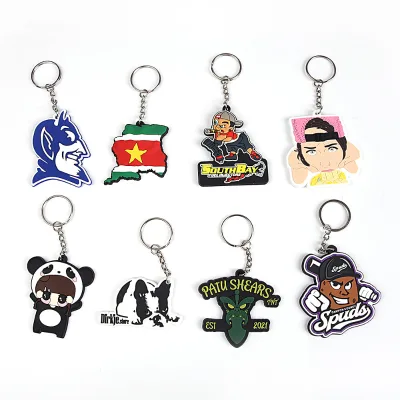


Customized Promotional Cute Soft Rubber Keyring Rubber Silicone PVC Keychain
$0.20 - $0.25
MOQ: 100 Pieces

Custom Cartoon Design PVC Keychain Soft Silicone Keychain for Key Schoolbag Decoration
$0.45 - $0.55
MOQ: 100 Pieces


Comprehensive Sourcing Guide
Soft Silicone PVC Keychain Sourcing Guide
Sourcing soft silicone PVC keychains requires a nuanced understanding of material properties, manufacturing processes, and regulatory compliance. These items are ubiquitous in promotional marketing, corporate gifting, and retail accessories due to their durability, vibrant color retention, and low unit cost. Buyers must distinguish between rigid PVC, which offers structural integrity, and soft silicone or flexible PVC blends, which provide a tactile, premium feel. The decision between these materials often hinges on the desired aesthetic, the target audience’s age group, and specific functional requirements such as flexibility or resistance to tearing.
The procurement landscape for these goods is characterized by high customization potential and significant variability in supplier capabilities. Factories often offer OEM and ODM services, allowing buyers to imprint custom logos, select specific shapes, and choose from a wide palette of colors. However, this flexibility introduces complexity in quality control and lead time management. Buyers need to establish clear specifications early in the engagement to avoid discrepancies between the pre-production sample and the final bulk order, particularly when dealing with intricate designs or multi-color applications that require precise molding.
Product Scope and Observed Listing Signals
The market for soft silicone PVC keychains spans a diverse range of applications, from early childhood education tools to promotional gifts and collectibles. Observed listings indicate that products are frequently categorized under "Cartoon" styles, appealing to younger demographics or those seeking cute, aesthetic designs. These items are often marketed with early childhood education functions, suggesting they may incorporate educational elements like letters, numbers, or shapes. The age specification for many of these products is listed as under three years, which necessitates strict adherence to safety standards regarding small parts and material toxicity.
Commercial signals from suppliers reveal a wide range of minimum order quantities (MOQs), typically starting from 50 pieces and extending up to 5,000 pieces, with common thresholds around 100 to 500 pieces. This variability allows small businesses and large corporations alike to find suitable entry points, though lower MOQs often come with higher per-unit costs. Pricing observed in the market ranges from $0.07 to $1.50 per unit, reflecting differences in material thickness, complexity of design, and packaging requirements. Buyers should note that "soft" PVC or silicone variants may command a slight premium over rigid counterparts due to the additional processing steps required to achieve the desired flexibility.
Technical Specifications to Verify
Material composition is the most critical technical specification to verify, as terms like "PVC," "Rubber," and "Silicone" are sometimes used interchangeably or inaccurately in listings. While some suppliers list PVC as the standard material, others may specify rubber or silicone blends, each offering different tactile and durability characteristics. Buyers must confirm whether the product is made from pure PVC, which is cost-effective but may contain plasticizers, or a silicone blend, which is generally more hypoallergenic and durable. The material test results, such as SGS certification, should be explicitly requested to ensure the absence of harmful substances like phthalates, lead, or cadmium.
Manufacturing processes also significantly impact the final product quality. Die-casting is a common method for creating detailed keychains, but it requires precise mold engineering to avoid flash or incomplete filling. Buyers should verify the mold time, which can range from 25 days for new custom molds, and the sample time, typically 5 to 7 days. Additionally, the surface treatment, such as polishing or painting, affects the longevity of the color and finish. For products intended for children, it is essential to confirm that the keychain is non-washable if it contains electronic components or glued parts, or that it is fully washable if it is intended for frequent cleaning.
Compliance and Safety Documentation
Regulatory compliance is non-negotiable for soft silicone PVC keychains, especially those marketed for children or sold in regulated markets like the European Union and the United States. Buyers must ensure that suppliers provide valid test reports from accredited laboratories, such as SGS, to verify compliance with standards like EN71 for toy safety or CPSIA for children’s products in the US. These tests typically cover mechanical and physical properties, flammability, and chemical composition, ensuring that the product does not pose choking hazards or contain toxic substances.
Documentation should also include material safety data sheets (MSDS) and declarations of conformity. For promotional items not intended for children, compliance with general product safety regulations is still required, but the scrutiny is often less intense. However, buyers should not assume that a supplier’s claim of "Eco-Friendly Material" automatically implies compliance with all environmental regulations. It is the buyer’s responsibility to verify that the materials used are free from restricted substances and that the manufacturing process adheres to environmental standards, such as REACH in Europe.
Cost Drivers and Commercial Terms
The cost of soft silicone PVC keychains is influenced by several factors, including material type, mold complexity, order quantity, and packaging. Custom shapes and multi-color designs require more complex molds and longer production times, increasing the unit cost. Packaging options, such as individual OPP bags, polybags, or carton boxes, also add to the total cost, with more elaborate packaging suitable for retail presentation being more expensive. Buyers should request detailed quotations that break down these costs to understand the true value proposition.
Commercial terms and logistics play a significant role in the final landed cost. Suppliers often offer various shipping terms, including EXW, FOB, CIF, DDU, and DDP, each affecting who bears the risk and cost of transportation. Lead times are another critical factor, with production times typically ranging from 15 to 18 days after mold approval, plus shipping time. Buyers should plan for potential delays and consider expedited shipping options if necessary, though these will incur additional costs. Understanding these variables allows for more accurate budgeting and inventory planning.
Supplier Qualification and Quality Control
Selecting a reliable supplier involves verifying their production capabilities, quality control processes, and customer service responsiveness. Buyers should request samples to assess the quality of the material, the precision of the molding, and the durability of the attachment mechanism. It is also important to check the supplier’s experience with similar products and their ability to handle custom designs. Suppliers that offer fast sample turnaround and responsive communication are often better equipped to handle complex orders and resolve issues quickly.
Quality control measures should be clearly defined in the purchase agreement. This includes specifying acceptable defect rates, inspection criteria, and the process for handling non-conforming goods. Buyers may choose to conduct pre-shipment inspections or hire third-party inspection services to ensure that the products meet the agreed-upon standards. Additionally, suppliers should provide a warranty or guarantee against manufacturing defects, ensuring that buyers are protected against poor quality output. Establishing a clear quality control framework helps mitigate risks and ensures consistent product quality across orders.
Long-Term Procurement Checks
Building a long-term relationship with a supplier requires ongoing monitoring of performance, quality, and compliance. Buyers should regularly review supplier performance metrics, such as on-time delivery rates, defect rates, and responsiveness to issues. This data can help identify potential problems early and facilitate continuous improvement. It is also important to stay updated on changes in regulatory requirements and market trends, ensuring that the products remain compliant and relevant.
Sustainability and ethical sourcing are increasingly important considerations for long-term procurement. Buyers should inquire about the supplier’s environmental policies, waste management practices, and labor standards. Suppliers that demonstrate a commitment to sustainability and ethical practices are often more reliable partners for long-term collaborations. By maintaining open communication and conducting regular audits, buyers can ensure that their supply chain remains robust, compliant, and aligned with their corporate values.
FAQs
Can I customize the shape and logo of the keychain?
Yes, you can customize the shape and logo. The product accepts custom shapes and allows for customer logos. This customization is available for OEM and ODM orders, ensuring the design meets your specific branding needs.
What is the minimum order quantity for these keychains?
The minimum order quantity is 500 pieces for the standard model. Some variations may have an MOQ of 100 pieces. Buyers should verify the specific MOQ based on the selected product model and customization requirements before placing an order.
How long does it take to produce a custom order?
Production typically takes 15 to 18 days after sample approval. The mold time is approximately 25 days if new molds are required. Sample time is usually 5 to 7 days, allowing for design verification before full-scale manufacturing begins.
What materials are used to make these keychains?
The keychains are made from PVC plastic and rubber materials. Some options feature copper metal types with anti-rust properties. The materials are described as eco-friendly and meet specific standards like SGS testing for quality assurance.
Are these keychains suitable for early childhood education?
Yes, certain models include early childhood education functions. These items are designed for children under three years old. They are non-washable and do not require power, making them safe and suitable for educational play settings.
What packaging options are available for bulk orders?
Packaging options include carton boxes or individual OPP bags. Some models come in polybags with 100 pieces per big bag. The specific packing method depends on the product model and the buyer's shipping requirements.
Can I get samples before placing a large order?
Yes, samples are available within 7 days. The sample time is typically 5 to 7 days depending on the specific model. This allows buyers to verify quality and design before committing to the full production run.