Source Tamper Resistant USB Outlet for Commercial, Residential, and Industrial Use
Compare 30 verified listings for Tamper Resistant USB Outlet solutions suitable for commercial, residential, and industrial applications. Buyers can evaluate specifications like USB output, grounding types, and certifications including CE and RoHS to find the right fit.
Key considerations
Products List


American Standard GFCI White 15 AMP 125-Volt Self-Test Tamper Resistant Outlet
$5.00 - $10.00
MOQ: 300 Pieces




Comprehensive Sourcing Guide
Strategic Sourcing Guide for Tamper Resistant USB Outlets
Understanding the Core Product Category and Technical Architecture
When sourcing tamper-resistant USB outlets, buyers must first distinguish between the mechanical safety features and the integrated power delivery systems. The product category encompasses standard electrical receptacles designed with internal shutters to prevent foreign object insertion, combined with integrated USB charging ports. Based on observed market data, these units frequently feature a "Without Switch" configuration for standard applications, though "Manual Switch" variants are also available for specific control needs. The core functionality relies on a "Standard Grounding" or "Self grounding" mechanism to ensure electrical safety, a critical requirement for commercial and residential installations.
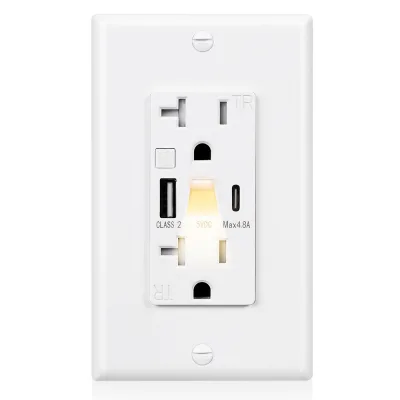
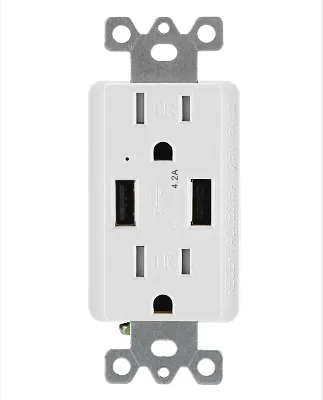
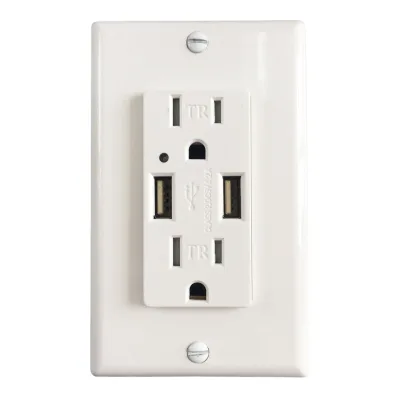
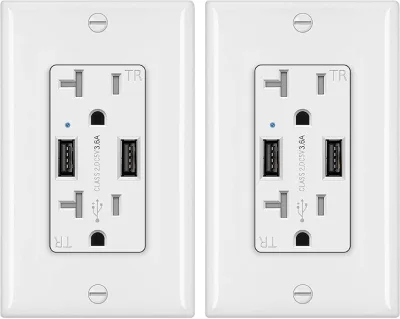
The physical construction typically utilizes a "Flame Retardant PC Plastic" shell, which provides durability and fire resistance. Some specifications indicate a composite material approach using "Brass, Pc, Plastic, Silver," suggesting that internal conductive elements may be brass while the housing remains plastic. The form factor is predominantly "Rectangular" with a "Porous" hole configuration, designed to accommodate various plug types while maintaining the tamper-resistant shutter mechanism. A key differentiator in this category is the USB integration; observed models often feature "2" USB ports with a combined output of "4.8A" at a standard "5V" voltage. This configuration is essential for powering multiple mobile devices simultaneously without requiring external adapters. Buyers should verify that the specific model number, such as "U202," "GFCI," or "LD-URL 15C-A-A," aligns with the required electrical standard of "125V" to ensure compatibility with local grid infrastructure.
Compliance, Certification, and Safety Standards Verification
Compliance is the most critical filter in the procurement of electrical components, particularly those involving USB charging capabilities. The market data indicates a strong presence of "CE" and "RoHS" certifications, which are fundamental for products entering the European and broader global markets. Additionally, specific high-confidence observations list "ETL" and "ISO" certifications alongside color specifications, suggesting that some suppliers provide products meeting North American safety standards (ETL) and international quality management systems (ISO).
Buyers must rigorously verify that the "CE" and "RoHS" marks are not merely marketing claims but are backed by valid test reports. The "RoHS" directive ensures that the product is free from hazardous substances, which is vital for environmental compliance. The "CE" marking indicates conformity with health, safety, and environmental protection standards for products sold within the European Economic Area. For the US market, where a significant portion of these products are targeted, the "ETL" certification is often a prerequisite for insurance and code compliance. It is essential to note that while "GFCI" (Ground Fault Circuit Interrupter) is listed as a model type, this implies a specific safety feature that trips during ground faults, which is a higher tier of protection than standard outlets.
When evaluating a supplier, procurement teams should request the full certification dossier. The presence of "ISO" certification suggests a commitment to quality management, but it does not replace product-specific safety testing. Buyers should confirm that the "125V" standard mentioned in the specifications aligns with the local grid voltage and that the "Self grounding" or "Standard Grounding" features have been tested for continuity and resistance. Without these verifications, the risk of non-compliance with local building codes and potential liability issues increases significantly.
Cost Drivers and Pricing Structure Analysis
The pricing structure for tamper-resistant USB outlets is influenced by several distinct variables, including material composition, certification depth, and order volume. The observed price range in the market spans from $0.10 to $30.00 USD. This wide disparity suggests that the lower end of the spectrum likely represents basic, non-branded units with minimal packaging, while the higher end includes models with advanced features like GFCI protection, premium branding (e.g., "Fahint"), or complex USB power management.
A primary cost driver is the material specification. Units constructed with "Flame Retardant PC Plastic" and internal "Brass" components generally command a higher price than those using lower-grade plastics or copper alloys. The inclusion of "2" USB ports with a "4.8A" output adds to the manufacturing complexity and cost compared to single-port or non-USB variants. Furthermore, the level of certification significantly impacts the final price. Products carrying "ETL," "CE," and "RoHS" simultaneously require more rigorous testing and documentation, which is reflected in the unit cost.
Order volume is another critical factor. The observed Minimum Order Quantity (MOQ) ranges from 50 to 5,000 units, with a specific high-confidence data point indicating an MOQ of 1,000 PCS for certain configurations. Suppliers often offer tiered pricing, where the unit cost decreases as the order volume increases. For buyers with smaller requirements, the "Small Orders: Accepted" attribute indicates flexibility, though the per-unit cost may be higher. Additionally, packaging requirements influence cost; "Carton Packing" is standard, but "with Inner Boxing Packing" adds material and labor costs. Buyers should negotiate based on the total landed cost, including the "Packing: 60PCS/Carton" efficiency, which affects shipping and handling expenses.
Typical Applications and Market Segmentation
The versatility of tamper-resistant USB outlets allows them to serve a broad spectrum of applications, from residential to heavy industrial environments. The market data explicitly lists "Commercial," "Industrial," "Hospital," "Laboratory," and "Residential/General-Purpose" as key application areas. In residential settings, these outlets are ideal for home offices and bedrooms where multiple devices need charging without cluttering the space with adapters. The "Home Appliance" application suggests integration into larger systems or specific room setups.
In commercial and hospitality sectors, such as hotels and offices, the "Convenient" and "Safety" features are paramount. The tamper-resistant mechanism protects against accidental insertion of foreign objects, which is a critical safety requirement in public spaces. The "USB Ourput: 4.8A" capability ensures that guests or employees can charge laptops, tablets, and smartphones efficiently. For industrial and laboratory environments, the "Flame Retardant" shell and "Standard Grounding" provide necessary protection against electrical hazards and fire risks. The "USA, Latin & South America" market focus indicates that these products are particularly suited for regions with specific electrical standards and high demand for modernized infrastructure.
The "General-purpose" classification implies that these units are not limited to a single niche but are adaptable to various installation scenarios. Whether in a "Hospital" setting where hygiene and safety are paramount, or in a "Commercial" office where device density is high, the product's ability to combine power and data charging in a single, safe unit makes it a versatile solution. Buyers should match the specific model, such as "GW15-IV" or "GW20-LA," to the environmental demands of the installation site, ensuring the "Condition: New" and "Customized" options meet the project's unique requirements.
Supplier Evaluation and Operational Capabilities
Selecting the right supplier requires a deep dive into their operational capabilities and customization options. The market data indicates that "Customization: Available" and "OEM: Welcome" are standard offerings, allowing buyers to brand the products or modify specifications to fit specific project needs. This flexibility is crucial for large-scale procurement where branding consistency or specific technical requirements are mandatory.
Lead time is a significant operational consideration. The observed "Delivery Date: Within 30 Days" suggests a relatively quick turnaround, which is beneficial for projects with tight deadlines. However, buyers must verify if this lead time applies to standard stock items or customized orders, as customization often extends production time. The "prod_origin: China" is a common source for these products, but buyers should assess the supplier's logistics network to ensure reliable shipping to the "Us" or "Latin & South America" markets.
Quality assurance is another critical evaluation point. The "Warranty: 1 Year" attribute provides a baseline for supplier confidence, but buyers should inquire about the terms of this warranty, including coverage for defects and replacement policies. The "Condition: New" specification confirms that products are not refurbished, which is essential for maintaining safety standards. When evaluating suppliers, buyers should also consider the "Small Orders: Accepted" policy, which can be advantageous for testing new product lines before committing to larger volumes. A supplier's ability to provide "Inner Boxing Packing" or "Carton Packing" options demonstrates their logistical maturity and attention to detail in product protection during transit.
Quality Control and Long-Term Procurement Strategy
Implementing a robust quality control (QC) strategy is essential for mitigating risks associated with electrical components. Buyers should establish clear acceptance criteria based on the observed specifications, such as verifying the "Flame Retardant PC Plastic" integrity and the "Self grounding" functionality. Pre-shipment inspections should focus on the "USB Port" count and output consistency, ensuring the "4.8A" rating is met under load. The "IP Rating" is listed as "IPNumber of Holes:Porous," which requires clarification; buyers must confirm the actual Ingress Protection rating (e.g., IP44, IP54) to ensure the outlet is suitable for the intended environment, especially in "Hospital" or "Industrial" settings where dust and moisture may be present.
Long-term procurement considerations involve building a sustainable supply chain. The "Customized" and "OEM" capabilities allow for product evolution over time, enabling buyers to adapt to changing technology standards or market demands. Buyers should also monitor the "Market" trends, noting the shift towards "Commercial, Electronic, General-purpose" applications. Establishing a relationship with a supplier that offers "Small Orders: Accepted" can facilitate a phased rollout, reducing initial capital expenditure while validating product performance.
Finally, the "Warranty: 1 Year" should be a cornerstone of the procurement agreement. Buyers must ensure that the warranty covers not just the physical product but also the electrical safety features, including the tamper-resistant mechanism and USB charging circuitry. By maintaining a rigorous QC process and leveraging the supplier's customization and warranty options, buyers can secure a reliable supply of high-quality tamper-resistant USB outlets that meet both current safety standards and future operational needs.
FAQs
What certifications do these outlets typically have?
These outlets typically carry CE and RoHS certifications to ensure safety and environmental compliance. Some models also include ETL and ISO marks for North American and quality management standards. Buyers must verify valid test reports for these marks before purchasing.
Can I customize the product with my own brand?
Yes, customization is available and OEM services are welcome for most suppliers. Buyers can request specific branding or modifications to fit project needs. This flexibility supports large-scale procurement where branding consistency is mandatory.
How long does delivery take for these units?
Delivery is typically completed within 30 days for standard orders. This lead time applies to stock items, though customization may extend production time. Buyers should confirm if the timeline covers shipping to their specific destination.
What is the minimum order quantity for these outlets?
The minimum order quantity ranges from 50 to 5000 units depending on the supplier. A specific high-confidence data point indicates an MOQ of 1000 pieces for certain configurations. Some vendors accept small orders, though the per-unit cost may be higher.
Which materials are used for the outlet shell?
The shell is primarily made of flame-retardant PC plastic for durability and fire resistance. Some specifications indicate a composite approach using brass, plastic, and silver for internal conductive elements. This ensures safety and longevity in various environments.
What is the USB output capacity for these models?
Observed models often feature two USB ports with a combined output of 4.8A at 5V. This configuration allows simultaneous charging of multiple mobile devices without external adapters. Buyers should verify the specific model number to ensure this capacity is met.
Where are these products manufactured?
The products originate from China, which is a common source for these electrical components. Buyers should assess the supplier's logistics network to ensure reliable shipping to the US or Latin American markets. Origin verification is essential for supply chain planning.