Source Toyota Brake Pads for Cars, Trucks, and SUVs
Find reliable Toyota Brake Pads from 30 verified suppliers offering semi-metal and steel options. Compare OEM standards, service life, and pricing to select the best fit for your automotive needs.
Key considerations
Products List




Comprehensive Sourcing Guide
Strategic Sourcing Guide for Toyota Brake Pads
Understanding Technical Specifications and Material Composition
When sourcing brake pads specifically for Toyota vehicles, the primary objective is to identify components that match the original equipment manufacturer (OEM) engineering tolerances while ensuring compatibility with the specific vehicle model. The market offers a diverse array of specifications, ranging from semi-metallic to alloy compositions. Based on available product data, the material composition is a critical differentiator. Some listings explicitly identify the material as "Semi-Metal," which is a common standard for high-performance braking applications due to its heat dissipation properties. Other entries indicate "Steel" or "Alloy" as the primary structural material, which may refer to the backing plate or specific friction formulation components.
The physical dimensions and model numbers are equally vital for verification. Sourcing guides must emphasize that "Toyota" is a broad brand encompassing numerous models, from the Corolla to the Land Cruiser. The product data reveals specific model identifiers such as "04465-33450," "04465-52010," and "41060-95F0A." These alphanumeric codes serve as the definitive reference for buyers to cross-reference against their vehicle's service manual. A mismatch in these codes can lead to installation failures or compromised safety. Furthermore, the "Position" attribute is frequently listed as "Front," indicating that many available units are designed for the front axle, which typically bears the majority of braking force. Buyers must verify whether the specific listing corresponds to the front or rear axle of their specific Toyota unit.
The classification of the product is consistently noted as "Disc" brake pads. This confirms that the search results are focused on disc brake systems rather than drum brake systems. The friction material must meet specific wear resistance standards, with some data points suggesting a service life of "≥50,000km" or "30,000-50,000 kms." However, these figures should be treated as observations from specific listings rather than universal guarantees. The actual service life depends heavily on driving conditions, vehicle weight, and the specific friction compound used.
Compliance, Certification, and Regulatory Standards
In the automotive aftermarket, compliance is not merely a formality but a prerequisite for liability protection and market access. The product data highlights several certification types that buyers should verify. Common certifications observed include "ISO," "IATF-ECE," "AMECA," "CCC," "ISO9001," "RoHS," "CE," "DOT," and "EEC." The presence of "IATF-ECE" suggests adherence to international automotive quality management standards, while "DOT" indicates compliance with U.S. Department of Transportation regulations.
Buyers must understand that not every product listing will possess every certification. The data shows variations; some entries list "ISO" alongside specific regional markets, while others list a comprehensive suite including "CCC" (China Compulsory Certification) and "RoHS" (Restriction of Hazardous Substances). When sourcing for export to North America, Europe, or South America, the specific certification requirements will vary. For instance, "ECE" marks are essential for European markets, whereas "DOT" is critical for the United States. The "Main Market" attributes in the data span a wide range, including South America, North America, Eastern Europe, Southeast Asia, and Africa. This indicates that suppliers often target multiple regions, but the buyer must confirm that the specific batch of brake pads carries the necessary certification for the destination market.
It is also important to note the "OE No." (Original Equipment Number) and "Reference No." fields. Listings may provide numbers like "581014de00" or "MD8514m, B1g12010512." These numbers are crucial for traceability. A supplier claiming to meet "OEM standard" must be able to demonstrate that their product matches the original part number specifications. The "Quality" attribute often mentions "100% Professional Test," which implies that the manufacturer conducts internal quality assurance checks. However, buyers should request independent test reports or third-party validation to confirm these claims, especially for high-volume procurement.
Cost Drivers and Pricing Structures
The pricing landscape for Toyota Brake Pads is influenced by several factors, including material composition, certification levels, and order volume. The observed price range in the market spans from $0.10 to $100.00 USD. This wide variance suggests that the market includes both low-cost, basic friction components and high-end, certified premium sets. The lower end of the spectrum likely corresponds to single pads or basic semi-metallic sets with minimal packaging, while the higher end may reflect complete kits with premium packaging, extended warranties, and comprehensive certification documentation.
The Minimum Order Quantity (MOQ) is a significant cost driver. Data indicates an MOQ range of 10 to 2,000 units. For small retailers or repair shops, an MOQ of 10 sets might be accessible, whereas large distributors may need to negotiate for volumes closer to 2,000 sets to achieve optimal unit pricing. Some listings specify an MOQ of "50 SETS" or "100 Set," which serves as a threshold for wholesale pricing. Buyers must calculate the total landed cost, which includes the unit price, shipping, and any tariffs, rather than focusing solely on the per-unit price.
Packaging also plays a role in cost. Options range from simple "Plastic Bag" to "Carton," "Wooden Case," or "Pallet" configurations. Customized packaging, often requested for branding purposes, may incur additional costs. The "Service Life" attribute, such as "≥50,000km," can also influence price; products claiming longer durability often command a premium. Buyers should be wary of prices that seem too low, as they may indicate compromised material quality or a lack of necessary certifications.
Typical Applications and Vehicle Compatibility
The application of Toyota Brake Pads is highly specific to the vehicle model and year. The product data lists several "Car Model" specifications, including "for Hyundai," "for Chiness Car," and "Isuzu D-Max," which indicates that while the core keyword is Toyota, the supplier catalog may be broad. However, specific Toyota-compatible model numbers are present, such as "04465-33450" and "41060-95F0A." These numbers are essential for ensuring that the brake pads fit the caliper and rotor assembly of the specific Toyota model.
The "Application" is universally listed as "Automotive Brake System," confirming the intended use. The "Color" attribute, listing options like "Black, Red, Blue," refers to the visual appearance of the brake pad backing plate or the friction material coating, which can be a factor for aesthetic customization in performance vehicles. However, color does not affect braking performance.
Buyers must be cautious when interpreting "For all cars" claims. While some listings suggest universal compatibility, the presence of specific model numbers like "D1541" or "D1920-8653" suggests that these are targeted at specific vehicle lines. For Toyota vehicles, the brake system design varies significantly between sedans, SUVs, and trucks. A pad designed for a Toyota Camry will not fit a Toyota Hilux. Therefore, the "Reference No." and "OE No." must be the primary verification tools, rather than generic "universal" claims.
Supplier Evaluation and Origin Verification
Evaluating suppliers requires a focus on their location, production capabilities, and market reach. The product data indicates origins in "China," with specific cities mentioned such as "Cangzhou," "Shandong," and "Hebei." These regions are known for their manufacturing hubs in the automotive parts industry. However, the location alone does not guarantee quality. Buyers should verify the supplier's physical address and request proof of business registration.
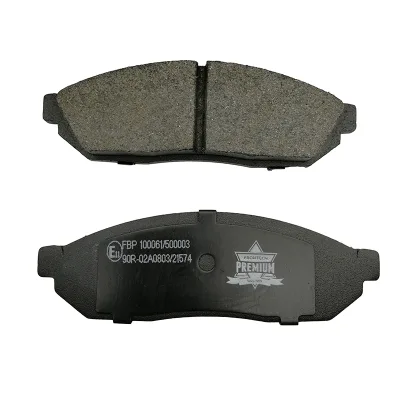
The "Brand Name" attribute, such as "Frontech Premium," suggests that some suppliers operate under their own branding. Others may offer "Neutral" packaging, which is common for private-label arrangements. When evaluating a supplier, buyers should check for the "Customization" attribute, which is listed as "Available." This indicates that the supplier can tailor products to specific requirements, such as custom packaging or specific friction formulations.
The "Main Market" data shows a global reach, including "South America," "North America," "Eastern Europe," and "Africa." This suggests that the suppliers are experienced in international trade and logistics. However, buyers should verify the supplier's experience with the specific target market's regulations. For example, a supplier experienced in the "Domestic Market" of China may not be familiar with the specific certification requirements for the "Western Europe" market.
Quality Control and Performance Verification
Quality control is paramount in the brake pad industry, where failure can lead to catastrophic safety issues. The data mentions "100% Professional Test" and "Wear Resistance: Meets Original Factory Standards." These are strong indicators of a commitment to quality, but they must be substantiated. Buyers should request detailed test reports that cover friction coefficients, wear rates, and noise levels.
The "Warranty" attribute, listing "30000-50000 kms," provides a benchmark for expected performance. However, warranties are only as good as the supplier's ability to honor them. Buyers should review the terms of the warranty, including what constitutes a defect and the process for claims. The "Service Life" of "≥50,000km" is another performance metric that should be verified through independent testing or customer feedback.
Packaging integrity is also a component of quality control. The "prod_packing" options include "Plastic Bag," "Carton," "Pallet," and "Wooden Case." Proper packaging protects the brake pads from moisture, dust, and physical damage during transit. For international shipping, "Wooden Case" or "Pallet" packaging is often required to meet export standards. Buyers should inspect the packaging upon receipt to ensure that the brake pads have not been compromised.
Long-Term Procurement and Supply Chain Considerations
Long-term procurement involves more than just the initial purchase; it requires a stable supply chain and consistent quality. The "Delivery Time" or "Lead Time" is a critical factor, with data indicating a range of "30-45 Days." This lead time can impact inventory management and production schedules. Buyers should negotiate lead times that align with their demand forecasts and consider the risk of delays due to logistics or production bottlenecks.
The "MOQ" of 10 to 2,000 units allows for flexibility in ordering. However, for long-term contracts, buyers should aim for a consistent MOQ that balances inventory costs with supply stability. Customization options, such as "Customized Packing" or specific branding, can add value over time by strengthening the buyer's market position.
Finally, the "Advantage" attribute, such as "High Efficiency," suggests that the supplier offers performance benefits. Buyers should evaluate these advantages in the context of their specific needs. For example, high efficiency might translate to better fuel economy or reduced brake fade, which are valuable selling points for end consumers. By focusing on these long-term factors, buyers can build a sustainable sourcing strategy that ensures safety, quality, and profitability.
FAQs
What certifications do Toyota Brake Pads typically have?
Many listings show certifications like ISO, IATF-ECE, AMECA, CCC, and DOT. Buyers must verify that the specific batch carries the necessary certification for their destination market, as not every product listing possesses every certification.
Which material types are available for Toyota Brake Pads?
Available materials include Semi-Metal, Steel, and Alloy compositions. Semi-metal is common for high-performance applications due to heat dissipation, while other entries indicate Steel or Alloy as primary structural materials for the backing plate.
How long is the service life of these brake pads?
Some data points suggest a service life of 30,000 to 50,000 kilometers or more than 50,000 kilometers. These figures should be treated as observations from specific listings rather than universal guarantees dependent on driving conditions.
Can I customize the packaging for my order?
Customization is available for packaging options such as Plastic Bag, Carton, Pallet, or Wooden Case. Buyers can request tailored packaging for branding purposes, though this may incur additional costs compared to standard neutral packing.
What is the typical minimum order quantity for these parts?
The observed MOQ range spans from 10 to 2,000 units, with specific listings requiring 50 or 100 sets. Small retailers may access lower thresholds, while large distributors often negotiate for higher volumes to achieve optimal unit pricing.
Which countries are the primary origins for these brake pads?
Products originate from China, with specific cities like Cangzhou, Shandong, and Hebei mentioned. These regions are known manufacturing hubs, but buyers should verify the supplier's physical address and business registration regardless of the specific city.