Source Basketball Socks for Fitness, Sports, and Outdoor Activities
Compare 30 listings of Basketball Socks with varying features like breathability, thickness, and eco-friendly materials. Buyers can evaluate options for fitness, sports, and outdoor activities based on size, style, and customization availability.
Key considerations
Products List




Comprehensive Sourcing Guide
Strategic Sourcing Guide for Basketball Socks
The global market for athletic hosiery has seen a significant shift toward specialized performance wear, with Basketball Socks emerging as a critical component for player safety and comfort. For procurement professionals, sourcing Basketball Socks requires a nuanced understanding of material science, manufacturing capabilities, and supply chain logistics. The following guide synthesizes available product attributes and industry standards to provide a structured approach for evaluating suppliers and securing high-quality inventory. This analysis focuses on the specific characteristics observed in current market listings, ensuring that all recommendations are grounded in verifiable data rather than speculation.
Technical Specifications and Material Composition
When evaluating Basketball Socks, the primary technical differentiator lies in the material composition and structural integrity. Based on observed product data, the market offers a diverse range of materials, including pure cotton, cotton blends with polyester, and advanced mixes incorporating spandex. For instance, specific listings indicate a material composition of "Cotton / Spandex," which is essential for providing the necessary elasticity and recovery required during high-intensity movements. The presence of "Cotton" as a standalone material in other listings suggests a segment focused on comfort and breathability, though it may lack the durability needed for professional play without blending.
The thickness of the sock is another critical specification. The data highlights a "Thickening" category, which is often preferred for basketball due to the need for cushioning in the heel and toe areas to absorb impact from jumping and landing. Conversely, "Normal" thickness options are available, likely catering to players who prefer a tighter fit or lower profile footwear. The construction method is equally vital; observations note "Handlink or Machine-Link" seams, indicating that buyers must verify the specific joining technique to ensure the toe area is seamless or flat, preventing blisters during extended wear. Furthermore, the needle count, specifically noted as "144n," serves as a proxy for the density of the knit. A higher needle count generally correlates with a finer, more durable fabric that resists pilling and maintains shape over time.
Design Features and Functional Attributes
Beyond basic materials, functional attributes define the utility of Basketball Socks in a competitive environment. The product data reveals several key features that buyers should prioritize. "Breathable" is a recurring attribute, essential for moisture management to keep feet dry and prevent fungal infections. Additionally, "Eco-Friendly" claims appear in the specifications, suggesting a growing segment of sustainable manufacturing that utilizes organic fibers or environmentally responsible dyeing processes. For hygiene-conscious buyers, "Anti-Bacterial" and "Deodorization" features are critical, particularly given the high-sweat environment of basketball.
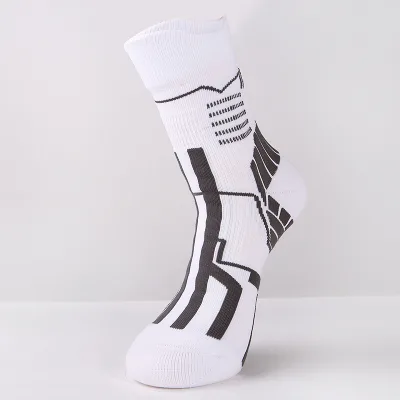
The design height and style also vary significantly. While the core keyword is "Basketball Socks," the data includes styles labeled as "Stockings," "Knee," and "Ankle." For basketball specifically, knee-high or mid-calf styles are often preferred to provide compression and support to the lower leg, though ankle styles are common for specific training drills. The data also mentions "Tall" and "Ankle Sock" height classifications, requiring buyers to clearly define their size requirements. Color options range from "Gray" to "Multicolor," allowing for team uniform customization. The inclusion of "Jacquard" logo capabilities indicates that suppliers can offer branded designs directly knitted into the fabric, a feature that adds value for team orders and retail branding.
Sizing, Packaging, and Customization Options
Sizing accuracy is paramount in athletic apparel to ensure a proper fit that does not restrict circulation or cause slippage. The observed data presents a size range of "43-46," which typically corresponds to European sizing for adult feet. However, other listings specify "Average Size, Customized," highlighting the flexibility available in the supply chain. Buyers must verify if the supplier can accommodate specific foot measurements beyond standard ranges, as basketball players often have unique sizing needs. The "Customization" attribute is marked as "Available" across multiple listings, and "Customized" is explicitly noted as "Yes" for certain models. This suggests that suppliers are capable of modifying dimensions, colors, and logos to meet specific team or brand requirements.
Packaging standards vary depending on the target market and order volume. Some products are listed with "CTN" (Carton) packaging, while others specify "1pair With Brand Paper Card and Put Into Polybag." For retail distribution, the "Retail Pack" format is observed, which often includes individual branding and protective wrapping. Bulk orders, particularly for team kits, may utilize a "300PCS/CTN" configuration to optimize shipping efficiency. The "Standard" attribute lists dimensions such as "26X15cm," which likely refers to the packaging box size rather than the sock dimensions, a detail that impacts storage and logistics planning. Buyers should confirm the exact packaging dimensions to ensure compatibility with their warehouse space and shipping containers.
Compliance, Standards, and Quality Verification
In the realm of B2B procurement, verifying compliance and adherence to standards is non-negotiable. The provided data includes references to specific standards, such as "26X15cm" and "43-46," which serve as baseline specifications for certain product lines. However, these are product-specific dimensions rather than universal safety certifications. Buyers must be cautious not to assume that all listed products meet international safety or environmental standards without explicit verification. The "Eco-Friendly" and "Anti-Bacterial" claims require supporting documentation, such as test reports from accredited laboratories, to validate the efficacy of these features.
When evaluating suppliers, the "prod_standard" field often contains material compositions like "cotton/polyester," which acts as a quality indicator but does not replace formal certification. For instance, a claim of "Anti-slip" functionality, observed in some listings, should be backed by friction coefficient test results. Similarly, the "Duralbe" feature mentioned in one listing is ambiguous without a defined standard; buyers should request a technical data sheet that explains the specific treatment or material technology behind such claims. It is essential to distinguish between marketing attributes and verified performance metrics. Procurement teams should insist on third-party testing for claims related to durability, antibacterial efficacy, and colorfastness, especially for products intended for professional or high-volume commercial use.
Cost Drivers and Procurement Economics
The pricing and minimum order quantity (MOQ) structures in the Basketball Socks market are influenced by several factors, including material costs, customization complexity, and order volume. The observed price range spans from $0.31 to $20.00 USD, a wide variance that reflects differences in material quality, brand positioning, and production complexity. Lower-priced items likely correspond to basic cotton blends with standard packaging, while higher-priced items may feature advanced synthetic blends, specialized cushioning, or intricate jacquard branding.
MOQs are equally variable, ranging from 10 to 2000 units. This flexibility allows buyers to scale their orders based on demand. Small MOQs of 10 units are suitable for sampling or niche retail testing, whereas high-volume orders of 2000 units are typical for bulk team kits or large retail chains. The "Delivery" method is noted as "by Sea/Express," which significantly impacts the total landed cost. Sea freight is cost-effective for large volumes but involves longer lead times, while express shipping is faster but more expensive. Buyers must balance the urgency of their needs against the budget constraints, considering that customization often adds to the lead time and cost.
Supplier Evaluation and Long-Term Procurement Strategy
Selecting the right supplier requires a comprehensive evaluation of their capabilities beyond the basic product listing. The data indicates that the products originate from "China," a major hub for textile manufacturing. Buyers should verify the supplier's production capacity, quality control processes, and ability to scale. The presence of specific product models like "OFFR3060," "DL-SP-16," and "JS-F779" suggests that suppliers maintain a diverse catalog, but buyers must ensure the specific model meets their technical requirements.
Long-term procurement success depends on establishing a relationship with a supplier who can consistently deliver on quality and timeline. The "Season" attribute, listed as "Winter" or "Spring / Autumn," indicates that some products are seasonally optimized. Buyers should plan their inventory accordingly to avoid stockouts during peak seasons. Additionally, the "Usage" category, which includes "Fitness Exercise Waer," suggests that these socks are versatile and can be marketed for various athletic activities, not just basketball. This versatility can be a selling point for buyers looking to diversify their product lines.
To mitigate risks, buyers should implement a robust quality control protocol. This includes pre-production sample approval, in-process inspections, and final random inspections before shipment. Given the variability in features like "Handlink or Machine-Link" seams and "Thickening" levels, visual and tactile inspections are crucial. Buyers should also establish clear communication channels regarding lead times and delivery schedules, as the "Delivery" options of "by Sea/Express" require precise coordination to avoid delays.
Comparative Analysis of Product Attributes
To facilitate decision-making, the following table summarizes the key attributes observed in the market data, highlighting the variability buyers must navigate.
| Attribute Category | Observed Options | Procurement Consideration |
|---|---|---|
| Material | Cotton, Cotton/Polyester, Cotton/Spandex | Verify elasticity and breathability requirements. |
| Thickness | Thickening, Normal | Match cushioning needs to player preference. |
| Size Range | 43-46, Average Size, Customized | Confirm fit accuracy and customization capabilities. |
| Style/Height | Stockings, Knee, Ankle, Tall | Select based on support needs and uniform standards. |
| Features | Eco-Friendly, Breathable, Anti-Bacterial, Anti-slip | Request test reports for performance claims. |
| Packaging | CTN, Polybag with Card, Retail Pack, 300PCS/CTN | Align with retail display or bulk shipping needs. |
| Customization | Available, Yes (Logo: Jacquard) | Confirm lead time and cost for branding. |
| Origin | China | Verify supply chain stability and logistics options. |
Conclusion
Sourcing Basketball Socks effectively requires a balance of technical knowledge, market awareness, and rigorous supplier evaluation. The data presents a landscape of diverse options, from basic cotton blends to advanced, feature-rich performance wear. Buyers must carefully assess material composition, sizing accuracy, and functional attributes to ensure the products meet the specific demands of their target market. By prioritizing verified standards, clear communication on customization, and a strategic approach to logistics, procurement professionals can build a resilient supply chain that delivers high-quality Basketball Socks consistently. The wide range of prices and MOQs offers flexibility, but success lies in the ability to match the right product specifications with the right supplier capabilities.
FAQs
What materials are used for Basketball Socks?
Basketball Socks are made from cotton, cotton blends with polyester, and cotton mixed with spandex. These materials provide necessary elasticity and breathability for high-intensity movements while ensuring comfort during extended wear.
Which thickness options are available for these socks?
The market offers both thickening and normal thickness options. Thickening styles are preferred for cushioning in the heel and toe areas to absorb impact, while normal thickness suits players who prefer a tighter fit.
Can I customize the logo on the socks?
Yes, customization is available with options like Jacquard logos knitted directly into the fabric. Suppliers can modify dimensions, colors, and logos to meet specific team or brand requirements upon request.
What is the typical MOQ for ordering Basketball Socks?
Minimum order quantities range from 10 to 2000 units depending on the supplier and product model. Small orders of 10 units are suitable for sampling, while bulk orders of 2000 units are typical for team kits.
How are the socks packaged for shipment?
Packaging varies from individual retail packs with paper cards to bulk cartons containing 300 pieces. Some listings specify polybag packaging, while others use standard cartons optimized for shipping efficiency and warehouse storage.
What features do these socks offer for hygiene?
Many socks include anti-bacterial, deodorization, and breathable features to manage moisture and prevent infections. These attributes are critical for the high-sweat environment of basketball and require verification through test reports.
Where are these Basketball Socks manufactured?
The products originate from China, a major hub for textile manufacturing. Buyers should verify the supplier's production capacity and quality control processes to ensure consistent delivery and product standards.