Source Foldable Lightweight Dog Stroller for Cats, Small Pets, and Travel
Explore 30 options for a Foldable Lightweight Dog Stroller designed for cats, small animals, and daily travel. Compare features like one-click folding, waterproof materials, and OEM customization to find the right carrier for your business needs; compare the available evidence and request quotations based on your requirements.
Key considerations
Products List


Durable Pet Stroller for Small Dogs and Cats with Easy-Fold Lightweight Design
$7.83 - $11.00
MOQ: 10 Pieces

Detachable Pet Stroller for Small and Medium Dogs with Easy Walking Design
$35.00 - $38.00
MOQ: 10 Pieces


Durable Foldable Pet Stroller for Cats and Dogs with Detachable External Carrier
$21.99 - $24.00
MOQ: 10 Pieces


Dog Trolley Stroller Pet Strollers Small Dogs Folding Customized Pet Dog Stroller
$62.00 - $74.00
MOQ: 260 Pieces


Pet Strollers Pet Stroller for Outings, Small Pull Cart, Puppy Stroller
$16.99 - $25.99
MOQ: 50 Pieces


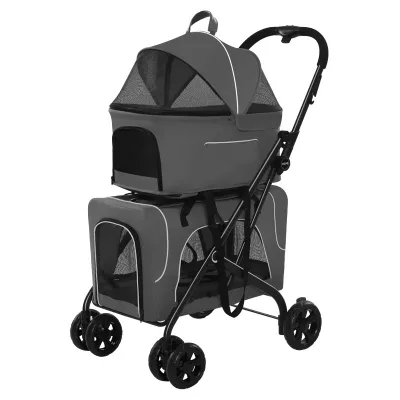


Easy Travelling Pet Stroller Detachable Design Foldable Lightweight Pet Stroller
$47.30 - $53.60
MOQ: 1 Pieces


Comprehensive Sourcing Guide
Foldable Lightweight Dog Stroller Sourcing Guide
Foldable lightweight dog strollers serve pet owners who need portable transport for small to medium dogs, cats, and small animals. The category spans single-layer units, double-layer carrier designs, and detachable models where the carrier separates from the frame for use as a shoulder bag or travel crate. Buyers sourcing for retail or distribution should first map their target market segment, because loading capacity, folding method, and material choices vary significantly across these configurations. Listings in this category typically advertise folding mechanisms such as one-click quick fold or manual fold, and these differences directly affect end-user satisfaction and return rates.
This guide walks procurement teams through the full sourcing cycle: defining product scope from listing signals, verifying technical specifications, securing compliance documentation, understanding cost drivers, qualifying suppliers, and planning long-term procurement checks. Throughout, the emphasis is on verifying seller claims against documented specifications rather than accepting listing descriptions at face value. Given that customization, OEM/ODM services, and custom colorways are widely offered in this category, buyers can differentiate their offering—provided the underlying quality framework is confirmed before committing to volume orders.
Product Scope and Observed Listing Signals
Observed listings in this category cluster around several recognizable product types. The "Portable Folding Pet Dog Stroller" (model MAD240510) is listed with a one-click quick fold, four wheels, waterproof construction, a 20–29kg loading range, and a carton packing standard of 58×21×78cm. A "Detachable Foldable Pet Carrier Stroller" targets heavier loads at 30kg and above with a 2-piece MOQ, while an "Extra-Large Foldable Pet Dog Stroller" (model MAO240509, standard 89×23cm) covers the large-size segment. Complementing these are "Pet Carrier for Dogs Four in One" products—non-electric, plush-comfort carrier bags with shoulder-bag carrying type and S/M/L/customized sizing.
Listing signals buyers can use for shortlisting include: declared folding method (one-click vs. manual), wheel count, maximum loading weight bands (10–19kg, 20–29kg, 30kg+), material (polyester appears in carrier listings), and color options ranging from black/gray/yellow to multi-color palettes including pink and blue. Several listings explicitly state OEM/ODM acceptance, customization availability, and logo printing, which signals willingness to support private-label programs. Observed MOQs range from 1 to 1000 pieces depending on the listing, and observed prices span roughly USD 7.83 to 139.99—wide ranges that reflect genuinely different product tiers rather than a single commodity.
Technical Specifications to Verify
Begin with load-bearing verification. Listings declare maximum loading weight bands, but buyers should confirm whether the stated figure refers to static basket capacity or dynamic load under movement over kerbs and uneven pavement, which is the more demanding real-world condition. Request the frame material and joint construction details—aluminum versus steel tubing significantly changes both weight and durability. For folding performance, clarify whether "one-click quick fold" describes a true single-hand operation and what the folded dimensions are; the observed packing standard of 58×21×78cm gives a reference point for shipping cartonization and retail shelf fit.
Wheel and fabric specifications deserve equal attention. Confirm wheel diameter, whether front wheels swivel or lock, and brake type on at least the rear axle. For fabric, polyester is the declared material in carrier listings—verify denier weight, waterproof coating method (coating versus laminate), and zipper quality, since zippers are the most common failure point in detachable carrier designs. For four-in-one carrier products, confirm how each configuration (stroller, shoulder bag, car seat, crate) locks securely, and request samples of plush lining to check that "extra soft & plush" claims survive washing.
Compliance and Safety Documentation
One listing in the observed set declares RoHS, CE, ISO, and CCC certifications, which shows that documentation is obtainable in this category—but buyers must verify every certificate directly rather than relying on listing badges. Request certificate copies with scope statements that actually cover pet strollers or pet carrier products, check certificate numbers against issuing-body databases where possible, and confirm the certificate holder matches the manufacturing entity. CE marking for this product type generally relates to specific directives, so ask the supplier to identify which directives apply and what testing supports the declaration.
Beyond certificates, ask for physical and mechanical safety evidence: brake effectiveness tests, stability testing on inclines, folding-mechanism pinch-point assessment, and load tests at declared maximum weight plus a safety margin. For textiles, request confirmation regarding restricted substances in dyes and coatings—one background signal mentions OEKO-TEX, but buyers should treat this as unverified until documentation is provided. If products will ship to markets with children's-product-adjacent scrutiny, small-parts and sharp-edge checks on attachments matter. Document all verification outcomes in a supplier file, because auditors and retail partners increasingly request this chain of evidence before listing new pet product lines.
Cost Drivers and Commercial Terms
Observed price points range from roughly USD 7.83 to 139.99, and the spread maps mainly to capacity tier, folding mechanism complexity, wheel quality, and whether the product is a full stroller or a carrier conversion. Frame material and tubing gauge drive cost more than fabric, so if quotations vary widely for similar-looking units, ask for a material breakdown before comparing. Customization—custom colors, logo printing, custom sizing—adds tooling or print-setup charges, typically structured as one-time fees plus per-unit costs; request these itemized separately so unit-price comparisons across suppliers stay honest.
Observed commercial terms in this category include T/T and Western Union payment, and trade terms of EXW, FOB, CIF, CFR, and DDP. Buyers should compare quotations on a landed-cost basis: EXW prices look lowest but shift freight, insurance, and clearance risk to the buyer, while DDP simplifies budgeting at a premium. Observed MOQs range from 1 to 1000 pieces with several listings at 2 or 3 pieces—low MOQs enable sample validation but usually carry higher unit prices. Negotiate tiered pricing tied to volume milestones, confirm whether packaging (carton standard 58×21×78cm in one observed listing) supports efficient container loading, and agree payment schedules that protect cash flow during first-article and bulk production stages.
Supplier Qualification and Quality Control
Qualify suppliers through a structured sequence: business-license verification, factory audit (onsite or third-party), and reference checks with existing pet-product buyers. Several listings originate from China, with one carrier listing tied to Anhui Province—an established manufacturing region for pet products—so geographic clustering works in the buyer's favor when arranging audits. Prioritize suppliers that explicitly accept OEM/ODM and offer customization, because these signals usually correlate with in-house production capability rather than pure trading intermediaries. Ask for production-line photos and an org chart showing who owns QC responsibility.
Build quality control into the contract with three checkpoints: pre-production sample approval signed and dated, in-process inspection for orders above modest volumes, and pre-shipment inspection using an AQL-based sampling plan (negotiate the AQL level explicitly; do not leave it undefined). Define inspection criteria for the highest-risk attributes—folding-mechanism cycling, brake function, wheel attachment, zipper durability, and waterproof integrity—rather than relying on a generic "appearance check." Require that any declared certifications (CE, RoHS, ISO, CCC) remain valid for the duration of the supply relationship, with re-submission upon renewal. Keep rejected-batch procedures, root-cause requirements, and corrective-action timelines in writing to avoid disputes after quality failures surface.
Long-Term Procurement Checks
Long-term sourcing success depends on monitoring drift, not just the initial order. Establish periodic re-inspection—annually or per major order—covering the same folding-cycling, load, and brake tests used at qualification. Track field failure data from returns and reviews; if zipper failures or wheel loosening cluster in a production batch, demand batch traceability so affected units can be identified. Re-verify certifications on a calendar basis, since lapses commonly go unnoticed until a retailer or regulator requests documentation. When suppliers introduce revised models or material substitutions, require new samples and re-approval before accepting the change into ongoing orders.
Use the category's customization flexibility strategically as volumes grow. Suppliers offering custom colors, logo printing, and custom sizing (with S/M/L options observed in carrier listings) allow buyers to differentiate without switching factories, but each new variant should pass the same first-article approval as the original. Consolidate volume with one qualified primary supplier once reliability is proven, but retain a qualified secondary source to protect against capacity or compliance disruptions. Finally, review commercial terms annually—payment terms, MOQ tiers, and Incoterms should evolve with your order history. Buyers who maintain documented performance records will negotiate from strength at renewal, whether sourcing budget tier 10–19kg models or premium 30kg+ double-layer configurations.
FAQs
What is the maximum weight capacity for these strollers?
The maximum loading weight varies by model, ranging from 10-19kg to 30kg and above. Specific models support up to 29kg, while extra-large options handle heavier loads. Buyers should verify the exact capacity for their pet's size before purchasing to ensure safety and stability during transport.
Can I customize the color and logo on the stroller?
Yes, customization is available for both color and logo printing. Buyers can choose from standard colors like yellow, black, red, gray, or white, or request custom colors. OEM and ODM services are accepted, allowing for personalized branding and design adjustments to meet specific business requirements.
How does the folding mechanism work for portability?
Folding methods include one-click quick fold and manual fold options depending on the model. These mechanisms allow for easy storage and transport. The strollers are designed to be compact when folded, making them ideal for travel. Buyers should check the specific folding type required for their convenience.
What certifications do the pet strollers hold?
Certifications include RoHS, CE, ISO, and CCC for certain models. These standards ensure product safety and quality compliance. Buyers requiring specific regulatory approvals should verify the certification status of the selected model. This information is crucial for importing goods into regions with strict safety regulations.
What is the minimum order quantity for bulk purchases?
The minimum order quantity ranges from 2 to 3 pieces for most models. Some listings indicate an MOQ of 1 to 1000 units. Buyers can start with small quantities to test the market. Bulk discounts may apply for larger orders, so contacting suppliers directly is recommended for accurate pricing.
Are these strollers suitable for small dogs and cats?
Yes, the application includes cats, small animals, and dogs. The strollers are designed with comfort levels that are extra soft and plush. They feature waterproof materials and multiple carrying types. Buyers should select the appropriate size based on their pet's dimensions to ensure a comfortable and secure ride.