Source Portable Football Net for Racing, Entertainment, and Gift
Find 27 Portable Football Net options for sports training and entertainment. Compare custom sizes, materials like PE and PU, and mesh styles to find the right fit for your needs; compare the available evidence and request quotations based on your requirements.
Key considerations
Products List


Portable Easy-Setup Football Net for Backyard Games and Family Gatherings
$50.00 - $70.00
MOQ: 50 Pieces


Hot Selling Portable Three Sizes Quick Assembly Football Net Stable Frame Soccer Net
$9.80 - $13.00
MOQ: 100 Pieces


Wholesale 5-Player Durable High Quality Football Goal Net Folding Football Goal Net
$9.80 - $13.00
MOQ: 100 Pieces


High Tensile Portable Easy Installation Football Net for Sports Fields
$0.50 - $1.20
MOQ: 1 Square Meters




Comprehensive Sourcing Guide
Portable Football Net Sourcing Guide
Procuring portable football nets requires careful evaluation of customization capabilities, as the market offers extensive options for tailored dimensions and mesh configurations. Buyers should prioritize suppliers who explicitly state their ability to produce nets in specific sizes, ranging from standard training dimensions to custom lengths up to 100 meters. The availability of OEM services allows organizations to brand these nets for specific teams or events, ensuring that the final product aligns with unique operational requirements rather than generic stock items.
The material composition of the net is a critical factor determining longevity and performance under varying weather conditions. Most observed listings utilize high-tenacity materials such as PE, HDPE, PP, or PET, which provide essential durability and resistance to environmental degradation. When sourcing, verify that the selected material includes UV stabilization and waterproof properties to ensure the net remains functional during outdoor training sessions or competitive matches without rapid deterioration from sun exposure or moisture.
Product Scope and Observed Listing Signals
The product scope for portable football nets encompasses a wide variety of applications, including racing, entertainment, and general sports training. Listings frequently highlight features like wearproof construction and eco-friendly materials, indicating a focus on both safety and sustainability. Buyers must distinguish between standard models and those designed for specific high-intensity uses, as the intended application directly influences the required mesh density and rope thickness.
Observations of listing signals reveal a strong emphasis on customization, with many suppliers offering bespoke colors and dimensions to match specific team aesthetics or venue constraints. The presence of multiple product models suggests a diverse inventory capable of serving different market segments, from small-scale recreational use to professional training facilities. It is essential to confirm that the specific model selected supports the required weight capacity and structural integrity for the intended frequency of use.
Technical Specifications to Verify
Technical verification begins with the mesh size and wire diameter, which are critical for ball containment and net durability. Standard configurations often feature a 14x14 cm mesh size with wire diameters of 2mm or 3mm, though custom options are widely available. Buyers should explicitly request confirmation of these dimensions to ensure the net meets the specific regulatory or training standards required for their facility, as deviations can significantly impact gameplay and safety.
The structural design of the net, including whether it is knotted or knotless, also requires careful assessment based on the intended usage environment. Knotless nets often offer smoother surfaces that reduce ball friction, while knotted designs may provide superior tensile strength for heavy-duty applications. Additionally, the rope width, which can range from 2mm to 3mm or be customized, must be verified to ensure it can withstand the tension forces generated during active play without stretching or snapping.
Compliance and Safety Documentation
While specific certification documents are not universally listed in the provided data, buyers must demand evidence of material safety and structural reliability before finalizing any purchase. The use of eco-friendly and UV-stabilized materials suggests a baseline commitment to safety, but formal documentation regarding chemical compliance and tensile strength testing is necessary for professional procurement. Without these records, there is a risk that the nets may not meet local safety regulations or industry standards for public use.
Safety documentation should also cover the stability of the net frame and accessories, particularly the high-tenacity polyester components used in the construction. Buyers need to verify that all accessories meet the necessary load-bearing requirements to prevent collapse during use. Ensuring that the supplier can provide test results or compliance statements for the materials used is a vital step in mitigating liability and ensuring the safety of athletes and spectators.
Cost Drivers and Commercial Terms
Cost drivers for portable football nets are heavily influenced by the level of customization, material quality, and order volume. Suppliers often indicate that larger quantities result in more significant discounts, making bulk purchasing a strategic option for organizations with multiple facilities or long-term needs. The choice of material, such as PU versus standard PE, and the complexity of the custom size or color requirements will also directly impact the final unit price and overall budget.
Commercial terms regarding delivery and payment are equally critical, with many suppliers offering a lead time of approximately 10 days after payment confirmation. Buyers should clarify the specific delivery timeline and any potential delays associated with custom orders, as these factors can affect project schedules. Understanding the packaging methods, whether in bags, cartons, or wood crates, is also essential for calculating logistics costs and ensuring the product arrives in optimal condition.
Supplier Qualification and Quality Control
Supplier qualification should focus on their manufacturing location and their history of providing OEM and ODM services. Many observed listings originate from Shandong, China, a region known for its textile and sports equipment manufacturing capabilities. Buyers should verify the supplier's production capacity and their ability to maintain consistent quality across large batches, especially when dealing with custom specifications that deviate from standard models.
Quality control processes must be rigorously defined to ensure that every net meets the agreed-upon specifications for mesh size, material strength, and finish. Buyers should request samples, which are typically available within 7 to 10 days, to physically inspect the product before committing to a larger order. This step allows for the verification of critical attributes like waterproofing and UV resistance, ensuring that the final product will perform reliably in the intended environment.
Long-Term Procurement Checks
Long-term procurement success depends on establishing a reliable supply chain that can consistently meet evolving needs and quality standards. Buyers should maintain open communication channels with suppliers to monitor changes in material availability or production capabilities that could affect future orders. Regular reviews of supplier performance, including adherence to delivery times and quality consistency, are necessary to mitigate risks associated with supply chain disruptions.
Sustainability and adaptability are also key considerations for long-term partnerships, as the sports equipment market increasingly values eco-friendly practices. Buyers should assess whether suppliers are committed to using sustainable materials and processes that align with their own corporate social responsibility goals. By fostering a relationship based on mutual trust and clear expectations, organizations can ensure a steady supply of high-quality portable football nets that support their long-term operational objectives.
FAQs
What materials are used for portable football nets?
Portable football nets are typically constructed from durable materials such as PE, HDPE, PP, PET, or PU. These materials ensure the net is waterproof, UV stabilized, and eco-friendly. High tenacity polyester is often used for accessories to enhance strength. The choice of material impacts the net's durability and suitability for various sports training and entertainment applications.
Can I customize the size of a soccer net?
Yes, customization is available for soccer nets. You can specify custom sizes, with dimensions ranging from 1m to 100m in length and 1m to 6m in width. Specific models may offer standard dimensions like 6FT height by 12FT width. Customized colors and mesh sizes are also supported to meet specific training or racing requirements.
What is the typical lead time for delivery?
The typical delivery time is shipped in 10 days after payment. For samples, the preparation time is approximately 7-10 days. These timelines apply to standard orders, but bulk quantities may vary. Buyers should confirm specific lead times with suppliers, as production schedules and shipping methods can influence the final delivery date for customized nets.
What mesh sizes are available for football nets?
Common mesh sizes for football nets include 14x14 cm. The mesh shape can be hexagonal or square, depending on the specific model and customization requirements. Rope widths vary from 2mm to 3mm or can be customized. These specifications ensure the net is suitable for various sports games, training sessions, and entertainment uses.
Are these nets suitable for outdoor use?
Yes, these nets are designed for outdoor use. They feature UV stabilization and waterproof properties, making them durable against weather elements. The materials used, such as PE and HDPE, are wearproof and eco-friendly. These features ensure the net remains functional and intact during sports games, training, and entertainment activities in various outdoor environments.
What packaging options are available for shipping?
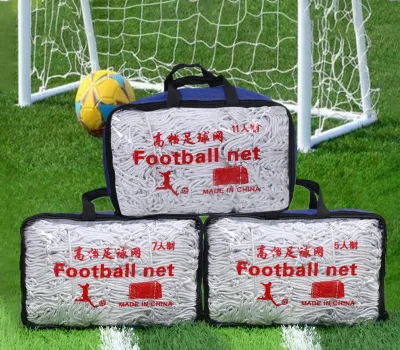
Packaging options include bags, cartons, or wood crates. The choice depends on the order quantity and shipping requirements. Standard packing is often in bags or cartons, while larger or more fragile items may require wooden packaging. This ensures the nets are protected during transit. Buyers can specify their preferred packaging method to meet logistical needs.