Source Portable Solar Home Lighting Kit with FM Radio for Camping, Home, and Industrial Use
Compare 30 Portable Solar Home Lighting Kit with FM Radio options featuring LED lamps, Li-ion batteries, and charging capabilities. Buyers can evaluate specifications like power, illumination time, and certifications from Chinese manufacturers for home, industrial, and outdoor applications.
Key considerations
Products List


Portable 2W 3PCS LED Home Light Solar Lighting Kits Power System with FM Radio
$22.90 - $24.90
MOQ: 1 Pieces

Solar LED Light Home Lighting Kits Hand Lamp Portable System FM Radio 3 Lights
$14.50 - $19.50
MOQ: 100 Pieces

Solar LED Light Home Lighting Kits Hand Lamp Portable System FM Radio Music Player Lights
$17.80 - $21.80
MOQ: 100 Pieces
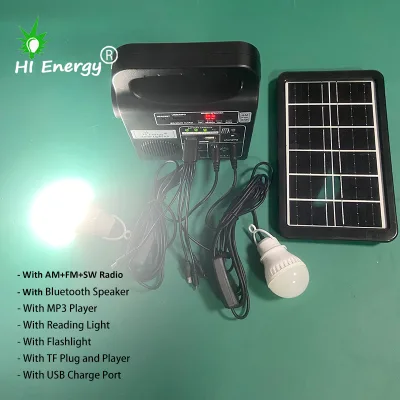


Solar Power System LED Solar Light Solar Home Kit with Torch Light MP3/FM Radio
$17.00 - $17.50
MOQ: 1000 Pieces


Comprehensive Sourcing Guide
Strategic Sourcing Guide for Portable Solar Home Lighting Kits with FM Radio
Understanding the Technical Architecture of Portable Solar Systems
When sourcing a portable solar home lighting kit with an FM radio, buyers must first dissect the technical architecture to ensure the product aligns with operational requirements. The core of these systems relies on a photovoltaic module to capture energy, a battery storage unit to retain power, and a lighting and audio interface for end-user utility. Based on observed market data, the solar panel component typically ranges from 3W to 8W in power output. Specific configurations often feature a single 8W poly-crystalline or mono/poly-crystalline panel, while more compact units may utilize a 3W, 6V panel with a 500mA output rating. The voltage specifications for these systems vary, with common observations including 7.4V and 12/24V configurations, necessitating careful verification of compatibility with the intended load.
The energy storage mechanism is critical for sustained operation during non-sunny periods. The majority of observed units employ Lithium-ion (Li-ion) batteries, with capacity ratings frequently cited around 5200mAh. This battery type supports a charging time of approximately 6 to 7.5 hours under sufficient sunshine conditions. Once charged, the illumination time can vary significantly based on usage patterns, with observed ranges spanning from 5 to 21 hours. Some specific models demonstrate variable runtime depending on the number of active bulbs; for instance, a configuration with three bulbs may provide eight hours of light, while reducing to one bulb can extend operation to 24 hours. The light source itself is predominantly LED-based, with common configurations including four 2W LED bulbs or three 1W LED bulbs. The LED lifespan is a key durability metric, with industry observations noting a potential lifespan of up to 50,000 hours.
The integration of the FM radio function adds a layer of complexity to the power management system. Buyers should verify that the radio component does not disproportionately drain the battery when the lighting function is not in use. The system description often highlights "Lighting & Phone Charging" as primary functions, with some models explicitly including a mobile phone charger capability. The input for alternative charging methods, such as an AC charger, is typically compatible with a 110V-240V range, offering flexibility in regions with inconsistent solar exposure. The physical construction of these units often utilizes ABS+PC materials for the body, ensuring resistance to impact and environmental factors, while the LED lamp material may involve an aluminum alloy crust and PCB for heat dissipation.
Compliance Verification and Certification Standards
Navigating the regulatory landscape is a fundamental step in the procurement of solar lighting kits. Compliance ensures that the product meets safety and environmental standards required for import and sale in various markets. The most frequently observed certifications in the current market data include CE and RoHS. The CE mark indicates conformity with health, safety, and environmental protection standards for products sold within the European Economic Area. RoHS compliance ensures that the product is manufactured without specific hazardous materials, which is crucial for electronic waste management and environmental safety.
Buyers must treat certification claims as observations that require validation rather than guaranteed attributes of every listed product. While the data indicates that products like the PS-K034A and JT-FD020F models carry CE and RoHS certifications, the presence of these marks on a specific listing does not automatically guarantee that every unit from that supplier meets the same standard. It is imperative to request valid test reports or certificates of conformity from the supplier. The standard verification process should confirm that the specific batch being purchased has undergone the necessary testing procedures. Additionally, some product descriptions mention "CE. ROHS" as a standard, suggesting a combined adherence to both directives.
Beyond CE and RoHS, buyers should investigate other potential regional requirements. For instance, if the target market is North America, FCC certification for the radio frequency components (the FM radio) might be necessary. While the provided data does not explicitly list FCC, the inclusion of an FM radio function inherently involves radio frequency transmission, making this a critical area for verification. The "IP Rating" mentioned in some contexts, though partially garbled in the source data as "IPIllumination Time," suggests that water and dust resistance ratings are a relevant consideration. Buyers should explicitly ask for the IP rating (e.g., IP44, IP65) to understand the product's suitability for outdoor or semi-outdoor installation. The origin of the products is consistently listed as China, which requires buyers to be vigilant about the authenticity of the certifications provided, as counterfeiting can occur in high-volume manufacturing hubs.
Cost Drivers and Pricing Dynamics
The pricing of portable solar home lighting kits is influenced by a complex interplay of component quality, customization options, and order volume. The observed price range in the market spans from $6.40 to $399.00 USD. This wide disparity indicates that the market offers products ranging from basic, entry-level units to high-end, feature-rich systems. The lower end of the price spectrum likely corresponds to kits with smaller solar panels (e.g., 3W), lower capacity batteries, and simpler plastic housings. Conversely, the higher price points may reflect larger 8W panels, more robust battery capacities, additional features like FM radios and phone charging ports, and premium materials such as aluminum alloy components.
Volume is a significant determinant of cost. The observed Minimum Order Quantity (MOQ) ranges from 1 to 1000 units. Buyers purchasing single units or small batches will typically face a higher per-unit cost due to the fixed costs of setup and logistics. As the order volume increases, the per-unit price generally decreases, reflecting economies of scale. The customization availability is another key cost driver. Products listed with "Customization: Available" allow for branding, color changes, or specific feature modifications. These customizations often incur additional tooling or setup fees, which can increase the initial cost but may be amortized over larger orders.
The technical specifications also directly impact the cost structure. A kit with a 5200mAh Li-ion battery and an 8W poly-crystalline panel will inherently cost more than a unit with a smaller battery and a 3W panel. The inclusion of an FM radio and mobile phone charging capabilities adds to the Bill of Materials (BOM) cost. Furthermore, the packaging type, such as a "Color Box," adds to the overall cost compared to bulk or neutral packaging. Buyers should analyze the total cost of ownership, including shipping and potential duties, rather than focusing solely on the unit price. The condition of the product is listed as "New," which is standard, but buyers should ensure that refurbished or open-box items are not inadvertently purchased at a premium price.
Typical Applications and Use Cases
The versatility of portable solar home lighting kits with FM radios makes them suitable for a diverse range of applications, primarily categorized into residential and industrial sectors. The "Home" application is the most prominent use case, where these kits serve as a primary or backup lighting solution in areas with unreliable grid electricity. In such scenarios, the ability to charge a mobile phone and listen to the radio provides essential connectivity and information access during power outages. The 5 to 21-hour illumination time ensures that families can maintain basic activities throughout the night.
In the "Industrial" sector, these kits are utilized for temporary lighting needs on construction sites, remote work camps, or emergency response operations. The rugged construction, often involving ABS+PC or aluminum alloy materials, makes them suitable for harsh environments. The FM radio function is particularly valuable in industrial settings for receiving weather updates or emergency broadcasts. The "Solar Panel Power System" description highlights their independence from the electrical grid, making them ideal for off-grid locations. The "Working Time" of 5 to 20 hours supports extended shifts or operations that cannot rely on conventional power sources.
The "Light Type: Solar" and "With Light Source: With Light Source" attributes confirm their suitability for outdoor and semi-outdoor applications. Whether used in a garden, a patio, or a temporary shelter, the portability of these units allows for easy relocation. The "Technics: Hand-woven" attribute mentioned in the data suggests that some components or accessories might involve traditional craftsmanship, potentially appealing to markets that value artisanal elements. However, the primary function remains the provision of reliable, renewable energy for lighting and communication. The "Color Temperature" options, such as Cool White and Warm White, allow users to select the ambiance that best suits their specific environment, whether it is a workspace requiring bright, focused light or a living area needing a softer glow.
Supplier Evaluation and Quality Assurance
Evaluating suppliers for portable solar lighting kits requires a rigorous approach to ensure product reliability and consistency. Buyers should prioritize suppliers who can provide transparent documentation regarding the "prod_model" and specific component origins. For example, the "LED Chips: Jing Yuan Brand" observation indicates that some manufacturers use specific, branded components, which can be a proxy for quality. Buyers should request a list of all critical components and their suppliers to verify that the same quality standards are maintained across different batches.
Quality control (QC) should be integrated into the procurement process from the outset. Given the variability in observed specifications, such as charging times ranging from 6 to 7.5 hours or illumination times from 5 to 21 hours, buyers must establish clear acceptance criteria. A robust QC plan should include pre-production samples, in-process inspections, and final random sampling. The "Condition: New" attribute is a baseline, but buyers must verify that the products are free from defects such as battery swelling, panel cracking, or radio interference. The "Details: ABS+PC" and "Lamp Body Material: Plastic" specifications require checks for material integrity and resistance to UV degradation.
Supplier communication is vital for managing expectations. Buyers should confirm the "prod_packing: Color Box" specifications to ensure that the packaging meets branding and protection requirements. The "AC Charger Input: 110V-240V" and "Plug Is Optional" details highlight the need for clear communication regarding plug types and voltage compatibility for the target market. Suppliers should also be evaluated on their ability to handle "Customization" requests, including branding and feature modifications. The "Standard: CE. ROHS" compliance should be verified through third-party testing reports rather than relying solely on supplier declarations. Finally, the "Location: China" origin requires buyers to be aware of potential logistics challenges and to establish clear terms regarding lead times and shipping responsibilities.
Long-Term Procurement and Lifecycle Management
Sourcing portable solar lighting kits is not merely a transactional activity but a strategic decision that impacts long-term operational efficiency and sustainability. The "LED Lifespan: 50, 000 Hours" is a critical metric for lifecycle planning, suggesting that the lighting component is designed for long-term use. However, the battery life is often the limiting factor in the product's overall lifespan. Lithium-ion batteries typically degrade over time, and buyers should inquire about the expected cycle life and replacement policies. The "Charging Time: 6-7hours Under Sufficient Sunshine" and "Illumination Time: 5-21 Hours" specifications indicate that performance may vary based on environmental conditions, necessitating a maintenance plan that includes regular cleaning of the solar panels and battery health checks.
Procurement strategies should also consider the "Customization: Available" aspect for future scalability. As the organization's needs evolve, the ability to modify the product design or branding becomes increasingly valuable. The "Functions: Lighting & Phone Charging" and "Mobile Phone Charger: Yes" features ensure that the product remains relevant as technology advances. Buyers should also evaluate the "Product Standard: CE. ROHS" compliance for future regulatory changes, ensuring that the products remain eligible for sale in target markets. The "Product Origin: China" and "Condition: New" attributes should be monitored to ensure that the supply chain remains stable and that the products continue to meet quality expectations.
In the context of sustainability, the "Solar Panel Power System" and "Light Source: LED Lamp" attributes align with global trends toward renewable energy and energy efficiency. Buyers should assess the environmental impact of the "Lamp Body Material: Plastic" and "ABS+PC" components, considering recyclability and end-of-life disposal. The "IP Rating" and "Working Time" specifications should be reviewed periodically to ensure that the products continue to meet the operational demands of the intended application. By adopting a long-term perspective, buyers can build a resilient supply chain that delivers value over the entire lifecycle of the product, from initial procurement to eventual replacement.
FAQs
What certifications do portable solar home lighting kits with fm radio have?
Most units carry CE and RoHS certifications to ensure safety and environmental compliance. Buyers should verify specific test reports for each batch as certification claims require validation rather than being guaranteed for every listed product.
How long does the battery last under sufficient sunshine?
The charging time typically ranges from 6 to 7.5 hours under sufficient sunshine conditions. Once fully charged, the illumination time can vary between 5 to 21 hours depending on the number of active LED bulbs.
Which solar panel specifications are common for these kits?
Common configurations include a single 8W poly-crystalline or mono/poly-crystalline panel. Some compact units may utilize a smaller 3W, 6V panel with a 500mA output rating for lower power requirements.
Can these kits charge mobile phones while providing light?
Yes, many models include a mobile phone charger capability alongside the lighting function. The system description often highlights lighting and phone charging as primary functions for off-grid connectivity.
What is the typical price range for portable solar home lighting kits with fm radio?
The observed price range spans from 6.4 to 399 USD depending on features and volume. Lower prices often correspond to basic units while higher prices reflect larger panels, better batteries, and additional features like radios.
How does the LED lifespan compare to traditional bulbs?
The LED lifespan is observed to be up to 50,000 hours, offering significant durability. This long lifespan ensures the lighting function remains reliable over extended periods without frequent bulb replacements.