Source Eco-Friendly Folding Basket for Picnic, Shopping, and Storage
Compare 30 eco-friendly folding basket options from verified suppliers in China. Buyers can evaluate models like SB066 and HBE-NY-69 based on material, capacity, and customization needs for picnic, shopping, and storage applications; compare the available evidence and request quotations based on your requirements.
Updated
Key considerations
Products List







Comprehensive Sourcing Guide
Eco-Friendly Folding Basket Sourcing Guide
Eco-friendly folding baskets occupy a practical middle ground between single-use bags and rigid shopping carts, and buyers who approach the category with a clear specification framework consistently secure better commercial outcomes. The listings observed for this guide span plastic portable baskets with double handles, folding polyester picnic-style shopping baskets, and stackable plastic folding crates used for fruit and produce handling. This diversity matters because "folding basket" can describe materially different products: a retail shopping basket carried by hand, a collapsible fabric basket for picnics or storage, and a rigid folding crate for logistics. Each variant carries different cost structures, testing needs, and customization possibilities, so the first sourcing decision is to fix which product family you actually need.
A second theme across the observed listings is flexibility in customization. Several products are explicitly offered as customized or non-customized variants, with colors available in various options or made to request, and customer logos accepted. Lead times in the observed data cluster around 30 days, with minimum order quantities ranging from as low as 10 pieces for some listings up to 3,000 pieces for others. Buyers should therefore treat the category as negotiable in both directions: small pilot orders may be feasible, while volume pricing improves substantially at standard MOQ thresholds. This guide walks through the specifications, documentation, cost drivers, and qualification steps that determine whether a given eco-friendly folding basket listing can support a durable supply arrangement.
Product Scope and Observed Listing Signals
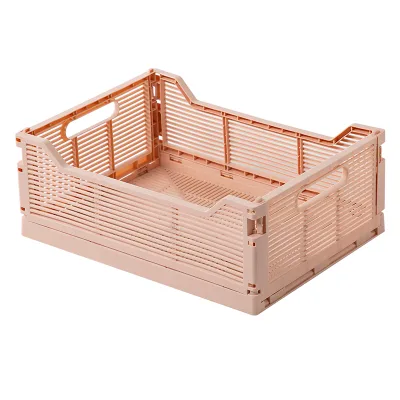
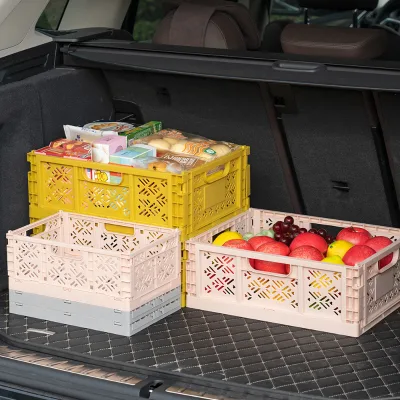
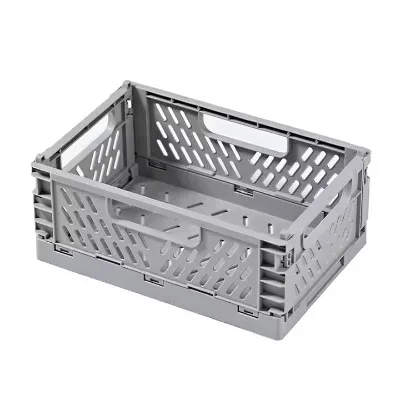
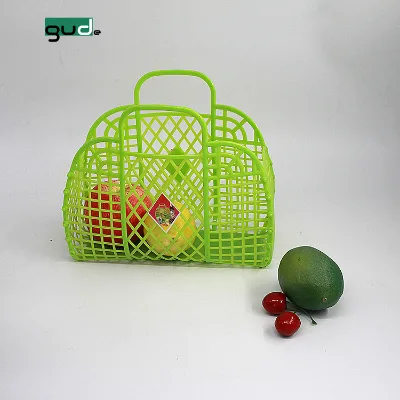
The observed product pages break into three identifiable groups. First, portable plastic shopping baskets such as models SB066 and SB068: these are described as new, portable, with double handles and without heat preservation, packed in a color sleeve, and originating from Guangdong. Second, folding polyester baskets such as the FB-3 and SB-FB-3, described as folding polyester picnic shopping baskets with foldable style, size made according to the buyer's request, colors available on request, and bulk packing at 10 pieces per carton from Jiangsu. Third, stackable plastic folding crates, including HBE and HBE-NY-69 models from Jiangsu Suzhou, with a listed size of 440×310×255 mm, export carton packing, and one listing specifying light-duty capacity. One crate listing cites a carrying capacity of 30 kg, which buyers should confirm applies to the specific model they intend to order.
Listing signals also reveal commercial signals worth reading carefully. Brand attribution appears on some listings, such as Highbright, while others are unbranded, which affects whether you are buying a manufacturer's line or a trading listing. Packing formats differ—color sleeve for retail-ready baskets versus bulk pack or export carton for industrial use—indicating which products suit supermarket front-end resale versus back-of-house logistics. Model numbering that repeats across listings (for example, FB-3 and SB-FB-3) suggests related product lines, so buyers should ask suppliers to clarify the relationship and whether specifications differ. Finally, "eco-friendly" positioning in this category rests on reusability rather than certified materials in most observed listings, so treat it as a marketing frame to be substantiated, not a guarantee of recycled content.
Technical Specifications to Verify
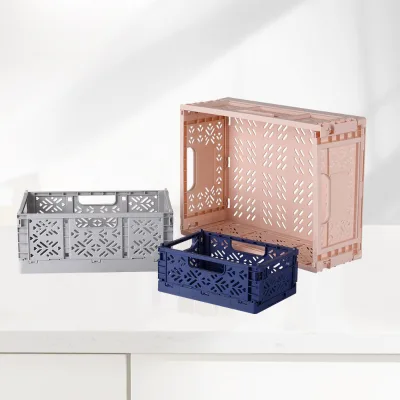
Start with dimensional and structural data. The observed listings show a range of approaches: one crate is fixed at 440×310×255 mm, one basket offers three sizes, and several explicitly state size according to the buyer's request or simply "customized." For a folding product, verify not only the open dimensions but also the folded height, since collapse ratio determines how many units fit in a carton and on a pallet. Confirm wall thickness and material grade for plastic models, and fabric weight plus frame material for polyester versions. Load rating deserves special attention: the single observed figure of 30 kg carrying capacity is attached to one listing only, so require the supplier to state rated load, and ideally test load, for the exact model quoted.
Folding mechanism durability is the most common failure point for this category. Ask for the number of fold-unfold cycles the hinge or crease system is designed to withstand, and whether replacement parts are available. For plastic baskets, confirm handle attachment method and whether the double-handle design is riveted, welded, or molded in one piece, since handle joints bear the full carried load. For stackable crates, verify stack height limits when loaded and whether stacking is intended with folded or unfolded walls. Also confirm color fastness for dyed polyester and UV resistance if baskets will be used outdoors or in store entrances. Document every specification in a written spec sheet attached to the purchase contract, so that first-article inspection has an objective reference.
Compliance and Safety Documentation
Observed listings reference several standards: one folding basket line cites CE, ROHS, and SGS; another cites CE, ROHS, and TUV; and the HBE crate line lists SGS. These references indicate that testing pathways exist for this category, but a listing mention is not the same as a certificate covering your order. CE marking for this product family typically relates to applicable European directives depending on the product's classification; ROHS concerns restricted substances in materials; SGS and TUV references usually point to third-party testing bodies rather than a specific standard. Buyers should request the actual certificate documents, verify the certificate number with the issuing body where possible, and confirm that the certified model matches the model number being quoted rather than a similar sibling product.
Food-contact relevance is a key question for baskets used with fruit, produce, or picnic food. If your use case involves direct food contact, ask the supplier to confirm which materials are food-grade and request corresponding migration test reports; do not assume this from an "eco-friendly" label. For polyester baskets, ask about azo dyes and other restricted substances depending on your destination market. Note that one supplier in the broader context is associated with BSCI, which relates to social compliance auditing rather than product safety—useful context for retailer requirements, but separate from product testing. Build a documentation checklist into your RFQ: test reports by material, certificates with validity dates, and a declaration that production batches match certified samples.
Cost Drivers and Commercial Terms
Observed pricing spans a wide band from 0.37 to 15 USD, which reflects the genuine cost spread between thin plastic crates, retail shopping baskets, and heavier folding polyester baskets. The main cost drivers to model are material type and grade, folding mechanism complexity, size, color (some suppliers charge setup for non-standard colors), logo application method, and packing format—retail color sleeves cost more than bulk packing. Customization is available on many observed listings, but customized tooling or printing typically raises unit cost and may raise the MOQ; one listing shows a 500-piece MOQ with 30-day lead time, another 1,000-piece MOQ, and crates as low as 10 pieces at the top of the observed price band.
Commercial terms deserve structured negotiation. Confirm what the quoted price includes: packing, inland freight to port, and whether the price assumes full container or less-than-container loads. The observed 30-day lead time is a reasonable planning baseline, but add buffer for peak season and for first orders that require samples and tooling. Ask how MOQ flexes for repeat orders, whether mixed models can share a container to meet MOQs, and what deposit and balance terms apply. For folding products, also quantify packing efficiency—pieces per carton and cartons per container—since a poorly collapsing design can inflate freight cost per usable basket by a meaningful margin. Always price landed cost, not ex-works price, when comparing suppliers.
Supplier Qualification and Quality Control
Qualify suppliers on their production reality rather than their listing claims. Ask whether the factory produces folding mechanisms in-house or outsources them, and request photos or a video call showing the molding or sewing lines relevant to your product family. Cross-check the declared origin—Guangdong for the plastic basket models, Jiangsu and Jiangsu Suzhou for the polyester and crate lines—against business license information. For customized orders, request a pre-production sample and treat it as the quality benchmark; one observed listing explicitly offers customized color and customer logos, which makes sample approval the natural control point before mass production.
Quality control should be built into the order, not assumed. Define an inspection protocol covering: dimensional checks against the agreed spec sheet, fold-cycle function testing on a sample of units, handle pull tests for carrying models, stack tests for crates, and packaging verification including carton count (the observed 10 pieces per carton for one model) and labeling. Decide whether you will rely on supplier self-inspection, third-party inspection, or your own team for pre-shipment checks, and state this in the contract. Agree on an acceptable quality limit and the remedy for failed inspections before placing the deposit. For ongoing programs, rotate inspection intensity: full inspection on first orders, reduced sampling once defect rates stabilize, and immediate reversion to tighter checks after any design or material change.
Long-Term Procurement Checks
Sustained value from this category comes from managing the relationship as a program rather than a series of transactions. Review reorder economics annually: as volumes consolidate, negotiate MOQ reductions, better color and logo terms, and improved packing efficiency. Track defect patterns over time—handle failures, hinge wear, color fading—and bring the data to supplier reviews, since concrete defect statistics are the strongest basis for requesting design improvements or price adjustments. Keep an approved, dated golden sample for each model on file, and re-reference it at every reorder to prevent gradual specification drift.
Build resilience against supply disruption. Because observed models come from different provinces—Guangdong and Jiangsu—consider qualifying a second source in a different region for your highest-volume basket model, even if the primary supplier performs well. Maintain documentation continuity: archive certificates, spec sheets, and inspection reports so that switching suppliers or answering retailer audits does not require reconstructing history. Revisit compliance requirements whenever you enter a new market, since food-contact and chemical rules may differ from those satisfied at initial sourcing. Finally, monitor whether "eco-friendly" claims in your own marketing remain substantiated—if you advertise recycled or certified materials, put the corresponding evidence requirements into the supply contract so the claim stays verifiable across production runs.
word check: roughly 1,400 words; structure matches requirements.
FAQs
Can I get eco-friendly folding baskets with custom logos?
Yes, customization is available for these baskets including custom logos. Some models support color options and specific design requests. You can request custom colors and logos from suppliers in Jiangsu or Guangdong. Lead times typically range around 30 days for customized orders. Minimum order quantities vary by supplier but often start at 500 pieces.
What materials are used for these folding shopping baskets?
These baskets are primarily made from plastic or polyester materials. Plastic versions often feature double handles and foldable designs for portability. Polyester options are described as foldable picnic shopping baskets. Both materials support various color options and can be customized. The carrying capacity for some plastic models reaches up to 30kg.
Which certifications do these folding baskets meet?
Many models meet CE, ROHS, and SGS standards for safety and quality. Some specific products also carry TUV certification. These certifications ensure the products comply with international safety requirements. Buyers can verify these standards when sourcing from manufacturers in China. Always confirm specific certification details with the supplier before placing an order.
How much is the minimum order quantity for these baskets?
Minimum order quantities typically range from 500 to 1000 pieces depending on the model. Some suppliers list an MOQ of 500 pieces for standard plastic folding crates. Other options may require 1000 pieces for customized polyester baskets. Bulk packing often includes 10 pieces per carton. Always check specific supplier requirements as MOQs vary by product type.
Where are these folding baskets manufactured?
These products are manufactured in China, specifically in Guangdong and Jiangsu provinces. Some factories are located in Jiangsu Suzhou. The origin is consistently listed as China for all observed models. Buyers can source directly from these regions for efficient logistics. Lead times from these locations are generally around 30 days.
What is the lead time for custom orders?
The standard lead time for these folding baskets is approximately 30 days. This duration applies to both standard and customized production runs. Customization options like logos or specific colors may require this timeframe. Buyers should plan their procurement schedule accordingly. Always confirm the exact lead time with the specific manufacturer before ordering.
Can these baskets be stacked and folded?
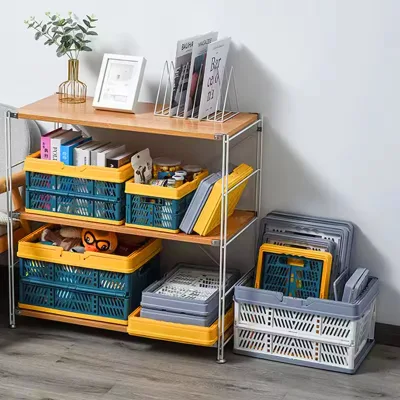
Yes, many models are designed to be both stackable and foldable. Plastic folding fruit crates are explicitly described as stackable. Polyester picnic baskets are noted for their foldable style. This design allows for efficient storage and transport. The folded state makes them portable and space-saving for users.