One Piece Silicone Spatula Suppliers and Manufacturers
Compare 26 verified suppliers offering one piece silicone spatulas with varying lead times, MOQs, and certifications like FDA. Review response times and customization options to select the right partner for your kitchenware needs; review the available evidence before requesting comparable quotations from suitable candidates.
Suppliers List

Xiamen Newtop Material Company
- Verified by TUVRHEINLAND
- Combined
- China Fujian
- Lead time15 days
- Avg. response≤ 2h
Main productsSilicone Pet Prodcuts, Silicone Housewares Product, Silicone Baby Product, Silicone Parts, Silicone Cap, Silicone Breast Pump, Slow Feeder, Silicone Pet Mat, Silicone Gasket, Silicone Hose
Main marketsEurope,North America

Jinhua Hengyang Cross-Border Trade Limited Liability Company
- Verified by SGS
- Trading Company
- China Zhejiang
- Lead time15 days
- Avg. response≤ 8h
Main productsCoffee Maker Air Fryer Storage Box Knife Set, Silicone Baking Mold Robot Vacuum Cleaning Table, Shower Head Non-Slip Shower Curtain Vacuum Stora, Collapsible Laundry Basket Bohemian Wall Tapestr, Fringe Pillow Cover Bedding Set Memory Foam Pill, Bamboo Tissue Biodegradable Trash Bags LED Fair, Smart Plug Fairy Lights Pet Food Bowl, Household Daily Necessities Kitchen Cleaning, Bathroom Storage and Care Fabric Home Decor, Bedding Daily Chemical Paper Products
Main marketsEurope


Gold-Plated Handles Stainless Steel Silicone Cookware Cooking Spatula Spoon Tool
$1.83 - $2.29
MOQ: 150 Pieces

Changsha Chengtong Technology Co., Ltd.
- Verified by SGS
- Trading Company
- China Hunan
- Lead time15 days
- Avg. response≤ 6h
Main productsCutting Board, Vegetable Chopper, Measuring Cup, Milk Frother, Measuring Spoon, Vegetable Peeler, Kitchen Scissors, Knife Sharpener
Main marketsSoutheast Asia/ Mideast
Shenzhen Kingfund Technology Co., Ltd.
- Verified by Intertek
- Manufacturer, Trading Company
- Lead time30 days
- Avg. response≤ 4h
Main productsSilicone Rubber Products
Main marketsDomestic Market(50%), North America(33%), Western Europe(17%)

GuangDong Infull Industrial Co., Ltd.
- Verified by TUVRHEINLAND
- Manufacturer/Factory
- China Guangdong
- Lead time45 days
- Avg. response≤ 3h
Main productsCutlery & Flatware, Dinnerware&Tableware, Tray&Lunch Plate, Ceramic Dinnerware, Kitchenware, Baking & Pastry Tools, Kitchen Knife, Kitchen Gadgets, Barware, Drinkware
Main marketsSouth America,Eastern Europe,Mid East,North America,Southeast Asia,Eastern Asia,Oceania,Western Europe,Africa


Customized Cooking Spatula Non-Stick Tools Heat Resistant Kitchenware Silicone Spatula
$0.39 - $0.45
MOQ: 100 Pieces


Zhongshan Xinyuan Silicone Rubber Co. Ltd
- Verified by TUVRHEINLAND
- Combined
- China Guangdong
- Lead time15 days
- Avg. response≤ 2h
Main productsSilicone Mold, Silicone Ice Cube Tray, Silicone Wristband, Silicone Tea Infuser, Silicone Bakeware, Silicone Keychain, Silicone Cup Coaster, Silicone Bag
Main marketsSouth America,Southeast Asia/ Mideast,Domestic,Europe,North America

TAIZHOU HARSOUL IMP. & EXP. CO., LTD.
- Trading Company
- China Zhejiang
- Lead time30 days
- Avg. response≤ 15h
Main productsPromotion Gifts, Promotional Bag, Promotional Jewelry, Promotional Toys, Promotional Stationery, Promotional Plastic Goods
Main marketsOthers(foreignTradeCapacity.exportBusinessCapacityMarketOther),Europe,North America


High Quality Personalized Premium Kitchenware Silicone Spatula for Baking
$0.90 - $1.50
MOQ: 1000 Pieces

Yiwu Riyuan Goods Trading Co.,Ltd.
- Trading Company
- Zhejiang, China
- Lead time15 days
- Avg. response≤ 5h
Main productsCake Decorating Supplies,cake board,Cake topper,Cake Tools,Baking & Pastry Tools
Main marketsNorth America(20.00%), Southeast Asia(19.00%), South America(16.00%), Western Europe(12.00%), Northern Europe(5.00%), Southern Europe(5.00%), Oceania(5.00%), Eastern Europe(5.00%), Eastern Asia(3.00%), South Asia(3.00%), Africa(3.00%), Central America(2.00%), Mid East(2.00%)
Dongguan Loyal Industrial Co., Ltd.
- Manufacturer, Trading Company
- Guangdong, China
- Lead time30 days
- Avg. response≤ 9h
Main productsSilicone Kitchen Utensils,Silicone Bakeware,Kitchen Accessories
Main marketsWestern Europe(30.00%), North America(30.00%), Northern Europe(10.00%), Southeast Asia(10.00%), Mid East(10.00%), Oceania(10.00%)

Milesun Rubber & Plastic Technology Co., Ltd.
- Verified by CTI
- Manufacturer/Factory
- China Guangdong
- Lead time23 days
- Avg. response≤ 12h
Main productsRubber Components, Rubber Damper/Shock Absorber/Sheet, Rubber-Metal Components, Sealing Ring, Home Appliance Rubber and Metal Components, Power Tool Rubber and Metal Components, Auto Rubber and Metal Components, Sanitary Rubber and Metal Components, Kitchen Ware / Daily Use Rubber Products, Food Grade Rubber Products/Toy
Main marketsSouth America,Eastern Europe,Mid East,North America,Southeast Asia,Eastern Asia,Oceania,Western Europe,Africa

Jinjiang Jiaxing Supply Management Co., Ltd.
- Verified by TUVRHEINLAND
- Trading Company
- China Fujian
- Lead time30 days
- Avg. response≤ 1h
Main productsEVA Clogs, Flip Flop, Shoe Charms, Shopping Bags, Wristbands, Gifts, Promotional Gifts, Slipper, Sport Cap, Ball
Main marketsNorth America
Shenzhen Kingod Silicone Products Co., Ltd
- Verified by TUVRHEINLAND
- Combined
- China Guangdong
- Lead time15 days
- Avg. response≤ 2h
Main productsBaby Set, Baby Products, Baby Goods, Breast Pump, Face Mask, Baby Bottle, Medical Components, Phone Case, Silicone Kitchen Products, Toys
Main marketsNorth America

Eagle Catering Equipment Co., Ltd.
- Manufacturer/Factory
- China Guangdong
- Lead time30 days
- Avg. response≤ 9h
Main productsTrolleys, Gastronorm Containers, Table, Shelves, Sink, Barrier Post, Cookware, Buffetware, Barware, Kitchen Utensils
Main marketsSouth America,Eastern Europe,Mid East,North America,Southeast Asia,Eastern Asia,Oceania,Western Europe,Africa

Zhongshan Mingxin Silicone Manufactory
- Verified by SGS
- Combined
- China Guangdong
- Lead time15 days
- Avg. response≤ 6h
Main productsSilicone Kitchenware, Silicone Keypaid, Silicone Bracelet, Silicone Wristband, Silicone Ashtray, Silicone Tube, Silicone Watch, Silicone Rubber, Silicone Sex Doll, Silicone Mold
Main marketsEurope,North America

Spatula Set 9 PCS Heat Resistant Silicone Baking Kitchen Spatula for Baking
$5.50 - $6.80
MOQ: 50 Pieces


YONGKANG HOMESHINE SILICONE PRODUCTS CO., LTD.
- Combined
- China Zhejiang
- Lead time23 days
- Avg. response≤ 25h
Main productsGlass Lid
Main marketsSouth America,East Asia(Japan/ South Korea),Domestic,Europe,North America


Non-Stick Silicone Baking Spatulas Set Butter Rubber Spatulas with Steel Core
$0.30 - $0.35
MOQ: 1500 Pieces

Wenzhou Cathylin International Trade Co., Ltd.
- Verified by TUVRHEINLAND
- Trading Company
- China Zhejiang
- Lead time15 days
- Avg. response≤ 13h
Main productsFlatware, Cutlery, Kitchen Tools, Tableware, Cookware, Bakeware, Drinkware
Main marketsNorth America
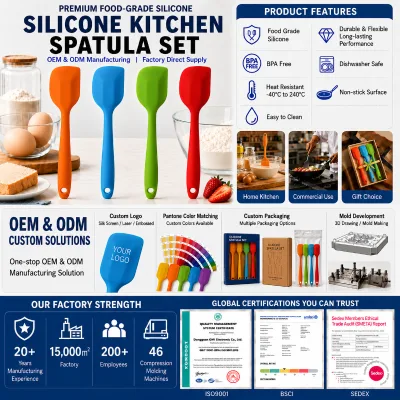
Dongguan GMI Electronic Co., Ltd.
- Verified by SGS Group
- Manufacturer, Trading Company
- Lead time15 days
- Avg. response≤ 3h
Main productsSilicone Baby Products, Silicone Kitchenware Products, Personal Care Product
Main marketsNorth America(47%), Eastern Asia(9%), Western Europe(8%)

- Verified by TUVRHEINLAND
- Manufacturer/Factory
- China Zhejiang
- Lead time45 days
- Avg. response≤ 3h
Main productsIce Bucket, Toys, Kitchen Products, Hip Flask, Shaker, Bar Caddy, Menu Board, Bottle Opener, Barwares, Wine Glasses
Main marketsSouth America,Eastern Europe,Mid East,North America,Southeast Asia,Eastern Asia,Oceania,Western Europe,Africa
Shenzhen Guangyufeng Rubber Co., Ltd.
- Verified by SGS
- Trading Company,Manufacturer/Factory
- China Guangdong
- Lead time23 days
- Avg. response≤ 3h
Main productsSilicone Product, Silicone Rubber Product, Baby Product, Silicone Tube, Silicone Rubber Roller, Silicone Sex Toy, Silicone Mold, Silicone Kitchenware, Silicone Case, Silicone Strap
Main marketsSouth America,Eastern Europe,Mid East,North America,Southeast Asia,Eastern Asia,Oceania,Western Europe,Africa

Silicone Spatula Set - Heat Resistant & Food Grade - 4 Piece Nonstick Rubber Spatul Tools
$0.50 - $15.00
MOQ: 50 Pieces


Ningbo General Union Co., Ltd.
- Verified by BV
- Trading Company
- China Zhejiang
- Lead time30 days
- Avg. response≤ 11h
Main productsCleaning Brush, Bottle, Kitchenware, Storage Box, Outdoor, Pet, Fitness Equipment, Digital Devices, Camping, Pet Bottle
Main marketsSouth America,Africa,Southeast Asia/ Mideast,East Asia(Japan/ South Korea),Europe,Australia,North America

- Verified by SGS
- Trading Company,Manufacturer/Factory
- China Zhejiang
- Lead time23 days
- Avg. response≤ 5h
Main productsTent, Project Screen, Bicycle, Trampoline, Backpack, Kitchenware, Hammock, Pet Accessories, Garden Products
Main marketsSouth America,Eastern Europe,Mid East,North America,Southeast Asia,Eastern Asia,Oceania,Western Europe,Africa

Yangjiang C&B Consumer Product Limited
- Verified by CTI
- Trading Company
- China Guangdong
- Lead time15 days
- Avg. response≤ 6h
Main productsBarbecue Tongs, Grilling Brushes, Outdoor Shovel, Grilling Tools, Kitchen Ware, Outdoor Products, Pizza Tools, Knife Set
Main marketsSouth America,Africa,Southeast Asia/ Mideast,Europe,Australia,North America
- Trading Company
- China Zhejiang
- Lead time30 days
- Avg. response≤ 11h
Main productsHome Appliance, Cookware Set, Thermos, Home Storage, Furniture, Pet Supplies, Garden Tools, Outdoor Supplies, Baby Supplies, Houesehold Items
Main marketsSouth America,Africa,Southeast Asia/ Mideast,East Asia(Japan/ South Korea),Domestic,Europe,Australia,North America

Silicone Spatula Set - Rubber Kitchen Spatulas for Baking, Cooking, & Mixing
$1.92 - $2.32
MOQ: 1000 Pieces

Dongguan Yangtai Silicone Products Co., Ltd
- Verified by SGS
- Combined
- China Guangdong
- Lead time15 days
- Avg. response≤ 3h
Main productsSilicone Bag, Silicone Pencil Case, Silicone Products, Silicone Kitchenware, Silicone Toys, Silicone Mold, Silicone Tap Night Light, Silicone Gift
Main marketsDomestic


Non-Scratch Silicone Cooking Spatula, High Heat Resistant Spoon for Daily Kitchen Use
$0.62 - $0.66
MOQ: 500 Pieces

Qingdao ShengHong Rubber and Plastic Co., Ltd
- Verified by TUVRHEINLAND
- Trading Company
- China Shandong
- Lead time15 days
- Avg. response≤ 6h
Main productsOil Sealing, Damping and Buffering, Flexible Fittings for Fluid Pipelines, Protective Seals, Sealing Strip, Metal Stamped Products, Framework Oil Seals, Stamping, Rubber Product, Rubber Seal
Main marketsEurope
- Verified by BV
- Trading Company,Manufacturer/Factory
- China Zhejiang
- Lead time23 days
- Avg. response≤ 5h
Main productsYoga Wear, Sports, Outdoor, Travel Gear, Kitchenwares, Homewares
Main marketsSouth America,Eastern Europe,Mid East,North America,Southeast Asia,Eastern Asia,Oceania,Western Europe,Africa








Comprehensive Sourcing Guide
One Piece Silicone Spatula Supplier Concentration and Factory Types
Current data indicates a concentration of manufacturing activity in China, specifically within the Fujian and Zhejiang provinces. Suppliers in these regions list main products that include silicone housewares, baking tools, and various silicone parts, suggesting a localized ecosystem for One Piece Silicone Spatula production. The Fujian cluster appears to feature combined company types capable of offering ODM, OEM, and own brand services, which often implies a direct factory presence or a tightly integrated supply chain. In contrast, suppliers in Zhejiang are identified as trading companies, which may source from various factories rather than manufacturing the items in-house. This distinction is critical for buyers seeking direct factory pricing versus those prioritizing a broader product range or consolidated logistics.
When evaluating the factory type, buyers should look for specific indicators in the supplier profile rather than assuming all listings represent direct manufacturers. The presence of combined company types in Fujian suggests a capability to handle customizations like logo printing and specific material requirements, which is often a hallmark of production facilities. However, the trading company classification in Zhejiang implies a different operational model where the supplier acts as an intermediary. Buyers must verify if the listed main products align with their specific needs, as trading companies might aggregate items like coffee makers or storage boxes alongside kitchenware. Understanding this structural difference helps in predicting communication flows and the depth of technical support available for complex customization requests.
How to Verify One Piece Silicone Spatula Suppliers
Verification of supplier credibility relies heavily on third-party audit reports and specific certification data provided in the search results. Some suppliers display verification status from recognized bodies such as TÜV Rheinland or SGS, which serves as a tangible indicator of operational compliance and quality management systems. For instance, a supplier with a TÜV Rheinland verification status offers a higher degree of assurance regarding their business legitimacy compared to those without such visible credentials. Buyers should prioritize suppliers where these verification badges are explicitly stated in the profile, as this data point is a concrete fact rather than a marketing claim. It is essential to confirm that the verification covers the specific entity handling the order, ensuring the audit applies to the actual production or trading unit.
Beyond general verification, specific product certifications provide further evidence of compliance with safety and quality standards. Product evidence shows that certain silicone items, such as baby spoons, carry FDA certification, which is a crucial benchmark for food-contact materials. While not every listing explicitly displays a certification, the presence of FDA or similar standards on specific SKUs indicates that the supplier has undergone testing for those items. Buyers should request to see the full certification documents for the specific One Piece Silicone Spatula model they intend to purchase, rather than relying on general company claims. If a supplier lists FDA certification for one product line, it is reasonable to inquire if the same standards apply to the spatulas, ensuring that the material safety is consistent across the requested order.
What to Compare Across One Piece Silicone Spatula Suppliers
Comparing suppliers requires a systematic analysis of key operational metrics such as lead time, minimum order quantity, and response speed. The data reveals significant variation in these areas; for example, response times can range from approximately 1.13 hours to over 7 hours, directly impacting the speed of negotiation and order confirmation. Lead times also differ, with some suppliers indicating a standard 15-day production window, while others may have different schedules based on their capacity and current order volume. Buyers should create a comparison matrix that includes these specific numbers to identify which suppliers can meet their timeline requirements without compromising on communication efficiency. A faster response time often correlates with better project management, which is vital for time-sensitive orders.
Minimum order quantities and pricing structures are equally critical factors in the comparison process. The observed data shows MOQs ranging from 50 units to 800 units, with prices varying from roughly $0.33 to $1.55 per unit depending on the specific product attributes and customization level. Suppliers offering lower MOQs, such as 50 units, may be more suitable for startups or test orders, whereas those requiring 800 units might be better for established brands seeking volume discounts. Additionally, the price range suggests that factors like material composition, handle design, and packaging options significantly influence the final cost. Buyers must weigh the trade-off between a lower unit price at a higher MOQ and the flexibility of a lower MOQ with a potentially higher per-unit cost, ensuring the total landed cost aligns with their budget constraints.
Common One Piece Silicone Spatula Sourcing Risks
One significant risk involves the discrepancy between product descriptions and actual material composition. While the core keyword focuses on silicone spatulas, some product evidence lists materials such as stainless steel for handles or mixed components, which may not meet the expectation of a fully silicone or specific material composition. For example, a listing for a spatula might specify a stainless steel handle with a silicone head, which could be acceptable or a dealbreaker depending on the buyer's strict material requirements. Buyers must scrutinize the detailed product attributes to ensure the entire unit or the critical contact surfaces match the desired specifications. Relying solely on the main product title without verifying the detailed attribute list can lead to receiving goods that do not meet the intended design or safety standards.
Another risk pertains to the consistency of customization capabilities and the reliability of sample availability. Although many suppliers list customization as available and samples as supported, the actual execution can vary based on the supplier's capacity and the complexity of the request. Some profiles indicate that OEM and ODM services are highly welcomed, while others simply state acceptance without detailing the process or lead time for custom molds. If a buyer requires a unique shape or specific color, the risk lies in the potential for delays or quality issues during the sampling phase. It is essential to verify the sample process explicitly, including who bears the cost and the timeline for approval, before committing to a large production run. Failure to clarify these details can result in significant delays and additional costs if the initial samples do not meet the required standards.
One Piece Silicone Spatula Regional Sourcing and Logistics
Regional sourcing strategies must account for the specific logistics hubs and shipping terms associated with different manufacturing clusters. Suppliers in Fujian and Zhejiang offer distinct logistical advantages, with some explicitly mentioning shipping terms like FOB Xiamen, EXW, or DDP options. The mention of Xiamen as a shipping point for Fujian-based suppliers suggests a direct access to major ports, which can streamline the export process for international buyers. Buyers should evaluate whether the supplier's preferred shipping terms align with their own logistics capabilities and cost structures. For instance, an EXW term requires the buyer to manage all transportation from the factory gate, while DDP terms offer a more hands-off approach but often at a higher price point.
Understanding the geographic origin of the products is also vital for estimating transit times and potential tariff implications. The product evidence confirms origins in China, specifically Fujian and Zhejiang, which are key manufacturing provinces. Buyers should verify the specific port of loading mentioned in the shipping terms to accurately calculate freight costs and delivery schedules. If a supplier lists multiple shipping options, such as sea, air, or express, the buyer must consider the urgency of the order and the cost sensitivity of the product. Air freight may be necessary for urgent restocking, while sea freight is more economical for large volume orders. Aligning the regional sourcing location with the appropriate logistics strategy ensures a smoother supply chain and minimizes unexpected delays or costs.
One Piece Silicone Spatula Commercial Terms and Order Planning
Commercial terms and order planning require a detailed review of payment structures, packaging standards, and warranty or return policies. The product evidence indicates that packaging often involves OPP bags, which is a standard and cost-effective solution for protecting the items during transit. However, buyers should confirm if custom packaging is available if branding is a priority, as some listings explicitly state that custom packages are accepted. The availability of logo printing and custom packaging options should be verified early in the negotiation process to ensure these services are included in the final commercial agreement. Clear communication regarding packaging requirements prevents misunderstandings and ensures the product arrives in a condition that meets the buyer's retail or distribution standards.
Order planning must also consider the production capacity and the ability to scale orders based on demand fluctuations. Suppliers with ODM and OEM capabilities often have the infrastructure to handle larger volumes, but buyers should confirm the maximum capacity and any potential bottlenecks. The lead time of 15 days observed in some profiles provides a baseline for planning, but buyers should account for potential delays during peak seasons or when customizations are involved. Establishing a clear timeline for sample approval, production, and shipping is essential for maintaining inventory levels. Additionally, buyers should discuss contingency plans for supply chain disruptions, ensuring that the supplier has the flexibility to adjust production schedules if unexpected challenges arise during the order fulfillment process.
FAQs
What is the typical lead time for silicone spatulas?
The typical lead time for silicone spatulas is 15 days based on current supplier data. Buyers should verify specific timelines with individual vendors as production schedules may vary depending on order volume and customization requirements.
What is the minimum order quantity for silicone spatulas?
Minimum order quantities for silicone spatulas range from 50 to 800 pieces depending on the specific product model. Some suppliers require 100 units while others accept orders as low as 50 pieces for certain items like jar spatulas.
Are silicone spatulas available with FDA certification?
Yes, some silicone spoon and fork sets are available with FDA certification. Buyers should confirm specific product certifications directly with suppliers since not all silicone kitchenware items listed carry this specific safety standard.
Where are the silicone spatula suppliers located?
Suppliers offering silicone spatulas are located in China, specifically in Fujian and Zhejiang provinces. Buyers can expect products to originate from these regions when sourcing one-piece silicone spatulas from the current supplier pool.
What is the price range for silicone spatulas?
The price range for silicone spatulas varies from 0.33 to 1.55 USD per unit. Specific costs depend on the product type, material composition, and order quantity, with some items priced as low as 0.33 USD and others up to 1.55 USD.
Do suppliers offer customization for silicone spatulas?
Customization is available for many silicone spatula products including color and logo printing. Suppliers welcome OEM and ODM requests, allowing buyers to tailor products to their specific branding and design needs.
What is the response time for supplier inquiries?
Supplier response times vary, with some vendors responding within 1.13 hours while others take up to 7.07 hours. Buyers should expect different reply speeds depending on the specific supplier they contact for their silicone spatula needs.