Source Hunting Camo Net for Agriculture, Camping, and Beach
Find 30 Hunting Camo Net options from Chinese manufacturers with customizable sizes, colors, and materials like nylon or polyester. Compare specifications including anti-UV protection, mesh types, and packing details for agriculture textiles, camping, and beach applications.
Key considerations
Products List


Tactical Style Outdoor Grass Hunting Camo Meshing Camouflage Net
$0.10 - $1.00
MOQ: 1000 Square Meters

Style Hunting Shooting Camouflage Net Camping Awning Woodland Net
$0.10 - $1.00
MOQ: 1000 Square Meters


Hunting Shooting Camouflage Net Camping Awning Woodland Style Training Nets
$1.00 - $3.00
MOQ: 1000 Square Meters


Outdoor Tactical Hunting Camo Net Factory Wholesale Multifunctional Waterproof
$2.00 - $3.00
MOQ: 2 Square Feet


U. S. Pink Hunting Camouflage Net Outdoor Tactical Camouflage Net
$1.80 - $2.00
MOQ: 1000 Square Meters

Polyester Woodland Camouflage Net Green and Brown Camouflage Net Camping Hunting Hidden Net
$9.90 - $10.00
MOQ: 1 Square Meters

Multifunctional Waterproof Hunting Camouflage Net for Outdoor Tactical Use
$2.00 - $3.00
MOQ: 2 Square Feet


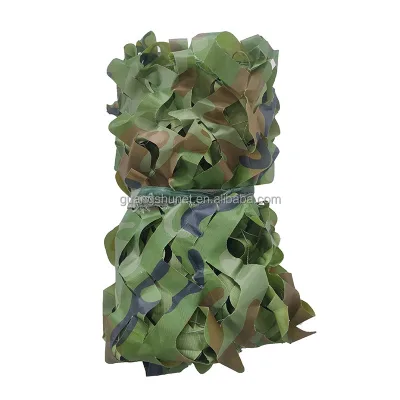


Camouflage Outdoor Net Factory Anti-Aging Shade Net Camouflage Net Hunting Net
$0.70 - $2.40
MOQ: 500 Square Meters


Comprehensive Sourcing Guide
Strategic Sourcing Guide for Hunting Camouflage Nets
The global demand for high-performance hunting camouflage nets has driven a complex B2B procurement landscape where technical precision and supply chain reliability are paramount. Buyers entering this market must navigate a diverse array of product variations, from standard agricultural textiles to specialized military-grade concealment gear. This guide provides a structured approach to sourcing hunting camo nets, grounded in observed product attributes and industry standards. The objective is to equip procurement professionals with the knowledge to evaluate suppliers, verify technical specifications, and mitigate risks associated with material quality and production consistency.
Technical Specifications and Material Composition
The foundation of any successful procurement strategy lies in a rigorous understanding of the product's technical specifications. In the current market, hunting camo nets are predominantly constructed from synthetic polymers, with Nylon and Polyester emerging as the primary materials of choice. These materials are selected for their durability, resistance to environmental degradation, and ability to hold complex camouflage patterns. The observed product data indicates that Nylon is a frequent material specification, often paired with specific denier counts ranging from 150d to 210d. This thickness specification is critical as it directly correlates with the net's tensile strength and its ability to withstand wind loads without tearing.
Mesh geometry is another vital technical parameter. The majority of high-quality hunting nets utilize a square mesh configuration, with mesh widths observed at 300cm in certain configurations. The mesh type determines the visual break-up of the human silhouette and the net's ability to blend into various terrains. Buyers must verify that the mesh type aligns with the intended environment; for instance, a square mesh may offer different concealment properties compared to a hexagonal weave. Furthermore, the weight of the material is a key indicator of quality, with observed ranges falling between 100g/m² and 200g/m³. It is essential for buyers to confirm the unit of measurement and the specific weight per square meter to ensure the net provides adequate coverage without being overly heavy for transport.
The functional attributes of the net are equally significant. Anti-UV properties are a standard requirement for hunting applications, as prolonged exposure to sunlight can degrade synthetic fibers rapidly. The presence of an Anti-UV treatment ensures that the camouflage pattern retains its color integrity and the material maintains its structural integrity over extended periods in the field. Additionally, the edge finishing, whether serging or open, impacts the net's longevity. Serged edges prevent fraying and extend the usable life of the product, whereas open edges may be suitable for temporary setups but require more frequent replacement.
Compliance, Certification, and Standard Verification
While specific certification bodies are not explicitly listed in the provided product data, the concept of standardized production is evident. The market features products adhering to specific size standards such as 23m, 34m, and 45m, alongside custom-made options. Buyers must treat these dimensions not merely as marketing claims but as verification points for compliance with their operational requirements. The existence of standardized sizes like 2525*31cm for packed units suggests a level of industrial standardization in packaging and logistics.
When evaluating compliance, procurement teams should focus on the "prod_standard" attributes observed in the supply chain. These range from fixed dimensions to fully customized orders. The presence of "Customized" as a standard option indicates that suppliers are capable of adapting to specific client needs, but this also introduces a variable in quality control. Buyers should request documentation confirming that the customization process adheres to the same rigorous quality standards as the standard SKUs. Furthermore, the origin of the product, primarily noted as China with specific hubs in Shanghai and Zhejiang, requires verification of local manufacturing standards. While specific international certifications are not detailed in the source text, buyers should inquire about adherence to ISO standards or local Chinese manufacturing regulations that govern textile safety and environmental impact.
Cost Drivers and Pricing Dynamics
The pricing structure for hunting camo nets is influenced by a confluence of factors, including material costs, production complexity, and order volume. The observed price range in the market spans from $0.10 to $16.00 USD, a wide variance that reflects differences in material quality, size, and customization levels. The lower end of this spectrum likely corresponds to basic, non-customized agricultural-grade nets, while the higher end may reflect specialized military-style patterns, enhanced UV treatments, or premium packaging.
Minimum Order Quantity (MOQ) is a significant cost driver, with observed ranges extending from 1 unit to 10,000 units. High-volume buyers can leverage economies of scale to reduce the per-unit cost, but they must balance this against inventory holding costs. The "Bale Packing" and "Caron Box Packing" options suggest that packaging choices also impact the final landed cost. Bulk bale packing is typically more cost-effective for large shipments, whereas box packing may be necessary for retail-ready units or smaller, specialized orders. Buyers should analyze the total cost of ownership, including shipping, duties, and packaging, rather than focusing solely on the unit price. The "Folded" attribute and "Self-Assembly" style mentioned in the data suggest that ease of deployment and storage efficiency are value-adds that can justify a higher price point.
Typical Applications and Usage Scenarios
The versatility of hunting camo nets extends beyond traditional hunting scenarios. The observed usage data highlights applications in Party, Camping, Traditional, and Beach settings. This indicates that the product line serves a dual market: professional outdoor enthusiasts and general recreational users. For hunting applications, the primary function is visual concealment, utilizing patterns like "Army Green," "Desert," and "Digital Camouflage Net" to blend into specific biomes. The "Visual Camouflage" attribute, noted as a "10 Years Professional Style," implies a long-term design intent for the patterns, ensuring they remain effective against modern detection methods.
In agricultural contexts, these nets function as shade nets, protecting crops from excessive sunlight while allowing necessary light penetration. The "Agriculture Textiles" classification confirms this dual utility. For camping and beach use, the "Waterproof" attribute becomes a critical feature, distinguishing these nets from standard shade cloths. The "No Elasticity" specification suggests that the nets are designed for rigid or semi-rigid support structures rather than stretchable applications. Buyers must match the specific application requirements with the correct product attributes; a net suitable for agricultural shading may not possess the necessary waterproofing or UV resistance for extended camping trips.
Supplier Evaluation and Origin Analysis
Evaluating suppliers requires a deep dive into their geographic and operational capabilities. The primary production hubs identified are in China, specifically in Shanghai and Zhejiang. These regions are known for their robust textile manufacturing ecosystems, offering a wide range of suppliers from small workshops to large-scale factories. The presence of multiple product models, such as "wm-320," "wm-520," "THC491," and "THZ28," indicates a diverse portfolio within the supply base. Buyers should use these model numbers as reference points for consistency and traceability.
When assessing a supplier, the focus should be on their ability to maintain consistency across different models and custom orders. The "Customization: Available" attribute suggests flexibility, but buyers must verify the supplier's capacity to handle custom requests without compromising quality. The "prod_packing" variations, ranging from simple bags to boxes and bales, also serve as an indicator of the supplier's logistical maturity. A supplier offering multiple packaging options is likely more experienced in handling diverse client needs. Additionally, the "Capacity: >10" attribute for certain products may refer to tent capacity or user load, which is relevant for buyers sourcing larger group equipment.
Quality Control and Long-Term Procurement Considerations
Quality control in the Hunting Camo Net sector must address both immediate performance and long-term durability. The "Anti-UV" and "Waterproof" attributes are not just features but performance metrics that require verification. Buyers should request test results or sample inspections to confirm that the UV resistance claims are valid and that the waterproofing does not degrade after repeated use. The "10 Years Professional Style" claim regarding visual camouflage is a long-term performance indicator that should be scrutinized; buyers should ask for evidence of colorfastness testing or historical data on pattern longevity.
Long-term procurement considerations involve establishing a reliable supply chain that can adapt to changing market demands. The availability of "Customized" standards and the wide range of "prod_model" numbers suggest that the market is dynamic. Buyers should develop relationships with suppliers who can offer continuous improvement and adaptability. The "Self-Assembly" style and "Folded" attributes indicate a trend toward user-friendly designs, which should be a priority in future procurement cycles. Furthermore, the "Edge: Serging or Open" specification highlights the importance of finishing quality. A supplier that consistently offers serged edges demonstrates a commitment to product longevity, which reduces the total cost of ownership for the buyer.
In conclusion, sourcing hunting camo nets requires a meticulous approach that balances technical specifications, cost efficiency, and supplier reliability. By focusing on the observed attributes such as material composition, mesh type, and functional standards, buyers can make informed decisions that align with their operational needs. The wide range of applications, from agriculture to recreational camping, underscores the versatility of these products, but also necessitates a careful selection process to ensure the right product is matched to the right use case. Through rigorous supplier evaluation and a commitment to quality control, procurement professionals can secure a supply chain that delivers consistent value and performance.
| Attribute Category | Observed Specifications | Procurement Verification Focus |
|---|---|---|
| Material | Nylon, Polyester | Verify denier count (150d-210d) and fiber blend for durability. |
| Dimensions | 23m, 34m, 4*5m, Customized | Confirm exact dimensions and mesh width (e.g., 300cm). |
| Functionality | Anti-UV, Waterproof, No Elasticity | Request test data for UV resistance and waterproof ratings. |
| Packaging | Bale, Box, Bag, Caron Box | Assess packaging for shipping efficiency and retail readiness. |
| Origin | China (Shanghai, Zhejiang) | Verify factory location and capacity for custom orders. |
| Models | wm-320, wm-520, THC491, etc. | Use model numbers for traceability and consistency checks. |
| Applications | Hunting, Agriculture, Camping, Beach | Match specific product attributes to end-use environment. |
By adhering to these guidelines and leveraging the detailed product data available, buyers can navigate the complexities of the Hunting Camo Net market with confidence, ensuring they source products that meet the highest standards of quality and performance.
FAQs
What materials are used for hunting camo nets?
Hunting camo nets are primarily constructed from Nylon or Polyester. These synthetic polymers offer durability and resistance to environmental degradation while maintaining complex camouflage patterns effectively.
Which mesh types are available for these nets?
The nets typically feature a Square Mesh configuration with mesh widths observed at 300cm. This geometry is selected to effectively break up the human silhouette for concealment in various terrains.
Can the nets be customized for specific sizes?
Yes, customization is available for specific size requirements beyond standard options. Buyers can request dimensions such as 2*3m, 3*4m, or 4*5m, or fully custom orders to meet operational needs.
What is the weight range of the net material?
The material weight ranges between 100g/m² and 200g/m³ depending on the specific product model. This weight indicator correlates with the net's tensile strength and ability to withstand wind loads.
Do these nets offer anti-UV protection?
Yes, the nets include Anti-UV properties to prevent rapid degradation from sunlight exposure. This treatment ensures the camouflage pattern retains color integrity and the material maintains structural strength over time.
What are the standard packaging options for shipment?
Packaging options include Bale Packing, Caron Box Packing, or simple Bag and Box formats. The choice depends on order volume and whether the units need to be retail-ready or bulk shipped.
Where are these nets primarily manufactured?
These nets are primarily manufactured in China, with specific production hubs located in Shanghai and Zhejiang. Buyers should verify local manufacturing standards when sourcing from these geographic regions.