Solar Powered Emergency Radio Suppliers and Manufacturers
Explore 10 verified suppliers offering solar powered emergency radios with varying lead times, response speeds, and certifications. Compare dimensions, battery capacities, and pricing to select the right partner for your needs; review the available evidence before requesting comparable quotations from suitable candidates.
Suppliers List

Shenzhen HXY Industrial Co., Ltd.
- Verified by TUVRHEINLAND
- Trading Company
- China Guangdong
- Lead time30 days
- Avg. response≤ 5h
Main productsSolar Power Systems, Solar Home Systems, Solar Lanterns, Solar Fans, Pay as You Go Solar Home Systems, Solar Home Lighting Systems, Solar Freezer, Solar Refrigerator, Solar Flashlight, Solar System
Main marketsDomestic

Telesol Energy Company Limited
- Trading Company
- China Guangdong
- Lead time30 days
- Avg. response≤ 6h
Main productsEnergy Storage System, Solar Home System, Hybrid Solar Inverter, Solar Reading Lamp, Solar Radio, Solar Lantern, Solar Torch, LED Lamp
Main marketsAfrica,Southeast Asia/ Mideast,Europe


Solar Powered Emergency Radio with Light, Bluetooth Speaker and All Bands Radio
$12.20 - $13.20
Moq: 500


Shenzhen Smile Technology Co., Ltd.
- Manufacturer, Trading Company, Distributor/Wholesaler
- Lead time旺季: "1 - 500":7,"501 - 1000":14,"> 1000":"To be negotiated", 淡季: "1 - 500":7,"501 - 1000":14,"> 1000":"To be negotiated"
- Avg. response≤ 3h
Main productsCameraPhoto&Accessories,Chargers Batteries&Power Supplies,Commonly Used Accessories&Parts,Computer Hardware&Software,Earphone&Headphone&Accessories
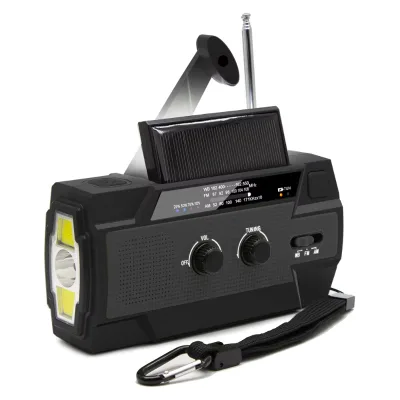
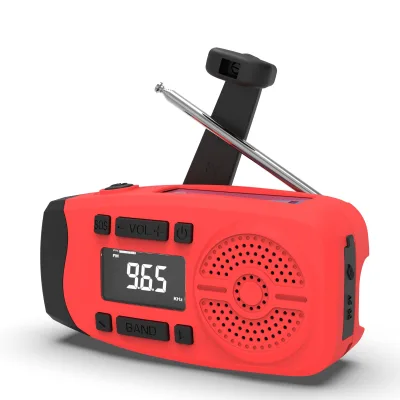
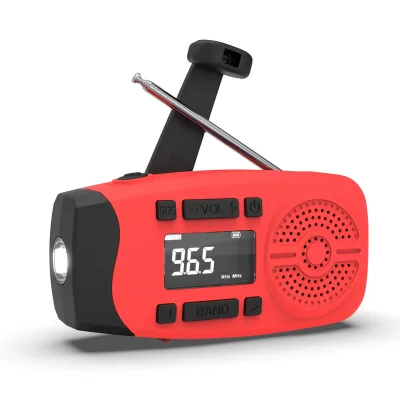
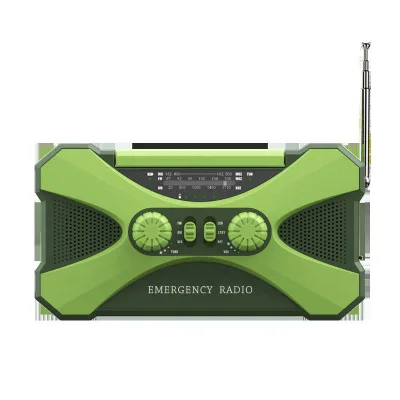
Emergency Solar Hand Crank Portable Radio Led Light 10000mAh Battery Portable Radio
$18.89 - $23.11
Moq: 10
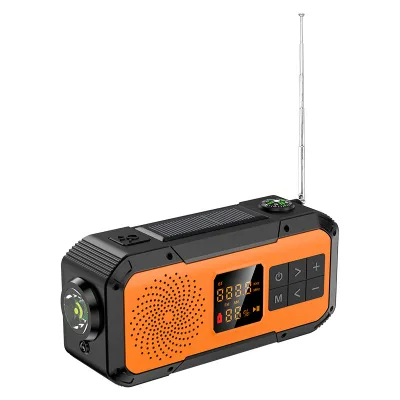
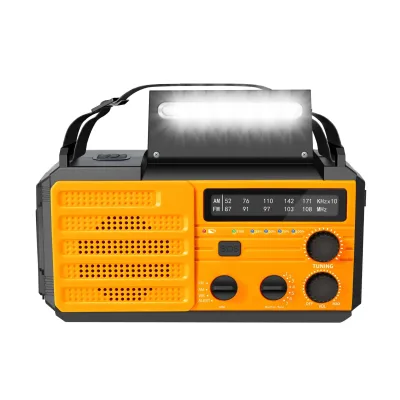
Emergency Radio Portable Charger Earthquake Solar Radio Hand-Crank Generator Flashlight
$19.08 - $22.55
Moq: 30
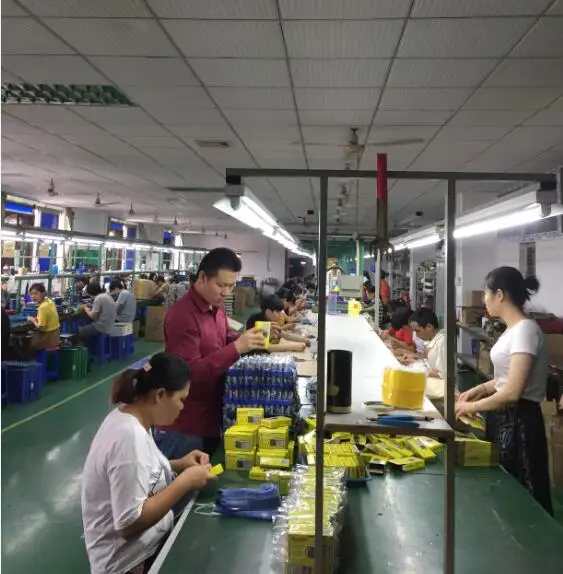
Shenzhen E-Style Technology Co., Ltd.
- Trading Company
- Guangdong, China
- Lead time20 days
- Avg. response≤ 3h
Main productsWalkie Talkie,Emergency Radio,Retro Radio,Bluetooth Speaker,portable radio
Main marketsDomestic Market(100.0%), South Asia(100.0%), Africa(100.0%), Southern Europe(100.0%), Eastern Asia(100.0%), Northern Europe(100.0%), Eastern Europe(20.0%), North America(20.0%), South America(15.0%), Southeast Asia(10.0%), Western Europe(10.0%), Mid East(10.0%), Central America(10.0%), Oceania(5.0%)

Huanyu Electronics Industrial Co., Limited
- Verified by BV
- Trading Company,Manufacturer/Factory
- China Guangdong
- Lead time15 days
- Avg. response≤ 10h
Main productsPower Bank, Wireless Charger, Bluetooth Speaker, Bluetooth Earphone/Earbuds/Headphone, Smart Watch, Drone, Charger/Adapter, Solar Radio, USB Cable, Other Mobiles& Computer Accessoriess
Main marketsSouth America,Eastern Europe,Mid East,North America,Southeast Asia,Eastern Asia,Oceania,Western Europe,Africa

Shenzhen BringYourHope Electronics Co., Ltd.
- Verified by TUVRHEINLAND
- Trading Company
- China Guangdong
- Lead time15 days
- Avg. response≤ 3h
Main productsPower Bank, Bluetooth Speaker, Digital Photo Frame, USB Flash Drive, Memory Card, Travel Adapter, USB Charger, Computer Speaker, Android TV Box, Mini PC
Main marketsOthers(foreignTradeCapacity.exportBusinessCapacityMarketOther),North America


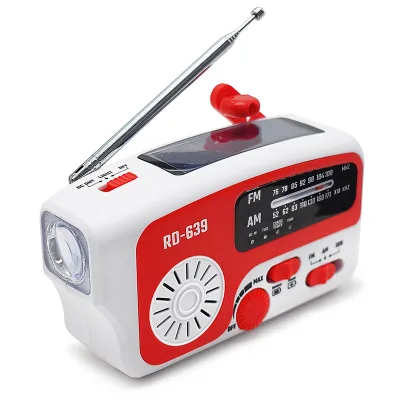
Popular Solar Hand-Cranked Power Generation Portable Charger Emergency Sos Noaa Radio
$10.15 - $10.35
Moq: 100

- Verified by CTI
- Trading Company,Manufacturer/Factory
- China Guangdong
- Lead time105 days
- Avg. response≤ 8h
Main productsBluetooth Speaker, Radio Receiver, Solar Energy, Car Motro Battery, TV DVD, Headphone Headset, Data Cable, Smart Watch
Main marketsSouth America,Eastern Europe,Mid East,North America,Southeast Asia,Eastern Asia,Oceania,Western Europe,Africa

Outdoor Bluetooth Speaker Solar System Flashlight Portable Emergency Solar Panel Bulb Radio
$13.58 - $13.96
Moq: 1000

Solar Small System Emergency Flashlight Solar Panel Radio Portable Outdoor Bluetooth Speaker
$12.68 - $13.06
Moq: 1000


OEM Frequency Device Portable Solar Radio Multi-Band Radio for Home with Torch
$4.58 - $4.88
Moq: 1000

Kaesid Kitchen Equipment (Shenzhen) Co., Ltd.
- Verified by TUVRHEINLAND
- Manufacturer/Factory
- China Guangdong
- Lead time0 days
- Avg. response≤ 6h
Main productsKitchen Equipment, Catering Equipment, Kitchen Furniture, Ice Cream Maker, Refrigerator, Bakery Equipment, Ice Maker, Home Appliances, Electric Griddle, Electric Pressure Cooker

- Verified by SGS
- Trading Company
- China Guangdong
- Lead time15 days
- Avg. response≤ 8h
Main productsConsumer Electronics, Car Accessories, Mini Thermal Printers, Garden Lights, Lawn Mower Accessories, Portable Speakers, Digital Camera, Mini Projectors
Main marketsOthers(foreignTradeCapacity.exportBusinessCapacityMarketOther),Europe

- Verified by TUVRHEINLAND
- Trading Company
- China Guangdong
- Lead time15 days
- Avg. response≤ 5h
Main productsAndroid TV Box, RF Modulator, Set-Top Boxes, Wireless Carplay Adapter, Android Auto Adapter, TV Stick, Smart TV, Smartphone
Main marketsAfrica




Comprehensive Sourcing Guide
Solar Powered Emergency Radio Supplier Concentration and Factory Types
When mapping the supply base for solar powered emergency radios, the most reliable starting point is the location data that suppliers themselves publish. Guangdong appears as a listed company location in current supplier results, and one product listing separately records a place of origin in Henan, China. This tells buyers that production and sourcing for this category are not confined to a single province, and that a supplier's registered address and a product's stated origin may differ. Before assuming a cluster, confirm where the units are actually assembled by asking for the manufacturing address tied to the specific model you intend to order.
Supplier types in this category vary. Current results include a trading company specializing in solar power systems, solar home systems, lanterns and radios, alongside a hybrid listing that identifies itself as a manufacturer, trading company and distributor/wholesaler. A pure trading company can aggregate multiple radio models quickly but may have less control over assembly quality, while a manufacturer listing may offer private molds — one result explicitly notes "private mold: Yes" — but narrower catalog flexibility. Ask each candidate to classify itself honestly and to state which radio models it produces in-house versus resells. Also review each supplier's main-product line: those whose catalogs center on solar home systems, lanterns and radios are more likely to have stable component supply than general electronics distributors. Never treat a company's self-declared type as proof of factory ownership without documentation.
How to Verify Solar Powered Emergency Radio Suppliers
Verification should begin with the credentials a supplier displays and end with evidence you request directly. In current results, at least one supplier carries a TUVRHEINLAND verification badge, while another shows no system certification at all — an explicit "NIL" in its certification field. This contrast matters: a displayed third-party verification badge gives you a documented starting point, whereas an empty certification field means you must ask for business licenses, factory audits or product test reports before committing. Do not assume that a supplier without a displayed certificate is unverified; some simply have not uploaded documentation. Equally, do not assume a badge covers the specific radio model you plan to buy.
Beyond documents, test responsiveness and consistency. Response times in current results range from roughly three hours to just over five hours, so log how quickly each candidate replies during your inquiry stage and whether answers are concrete or evasive. Cross-check the product listings themselves: one supplier's listings consistently name solar power systems, solar home systems, lanterns and solar radios, which suggests category focus, while another's main products span cameras, chargers, batteries and computer hardware, suggesting a broad distributor profile. For either profile, request photographs or samples of the exact emergency radio model — hand-crank variants, weather-alert models and Bluetooth-speaker combinations all appear in current listings — and confirm the stated attributes, such as battery capacity, solar panel wattage and charging methods, match what arrives. Ask whether customization is genuinely available; two listings state customization is available, but you should confirm what that means in practice before relying on it.
What to Compare Across Solar Powered Emergency Radio Suppliers
Build a comparison sheet from the attributes suppliers actually display, and record gaps as "not stated" rather than guessing. Dimensions visible in current results include lead time, minimum order quantity, response speed, location, verification status, company type and main products. Lead times differ meaningfully: one solar-focused trading company lists a 30-day lead time, while another supplier publishes tiered lead times — roughly seven days for 1–500 units and about fourteen days for 501–1000 units, with larger volumes quoted on request. These figures may reflect different order structures, so normalize them by asking each supplier for a written lead time against your specific quantity.
MOQs in current listings vary from as low as 10 pieces on one multifunction emergency radio to 500 pieces on a ham-radio-style flashlight unit, with another listing stating 100 pieces. Response times, noted above, range from about three to five hours. Price bands also differ: one listed radio sits at a single price point around nine dollars per unit, a solar emergency radio with LED torch is listed between roughly 12 and 13 dollars, and a weather-alert survival model spans roughly 17 to 20 dollars. Compare price only against identical specifications — battery capacity, solar panel wattage, crank charging and waterproofing all vary between models. Remember that not every supplier displays every attribute: establishment year, escrow availability and system certification were absent or marked NIL in some results, so request them directly and compare on documented facts only.
Common Solar Powered Emergency Radio Sourcing Risks
The most common risk in this category is specification drift between listing and delivered goods. Current listings carry detailed attributes — one model specifies a 2000mAh battery, 0.1W solar panel, 1W flashlight and solar/hand-crank/AC charging; another lists a 1200mAh battery, 1W solar panel and a 170x70x115mm body. These numbers are exactly what a factory can quietly change to cut costs. Insist on a golden sample, record every attribute from the listing, and make the sample the contractual reference for your order. Check whether the supplier modifies specs after you confirm: a changed battery grade or reduced solar panel wattage is hard to detect on arrival but obvious in field performance.
A second risk is overestimating what a listing's claims guarantee. One product places its origin in Henan while the supplier's registered location is Guangdong, so confirm the actual production site and who controls quality there. Supplier type ambiguity is another trap: a listing identifying itself as manufacturer, trading company and distributor simultaneously leaves unclear who assembles the radios. The "NIL" certification field on one supplier is not proof of a problem, but it does mean the buyer carries the full burden of verification. Watch also for vague working-time claims — one listing states flashlight and broadcast runtimes — and demand measured discharge tests on your sample. Finally, waterproofing and weather-alert functionality appear in product names but are rarely backed by displayed test evidence; ask for independent confirmation rather than accepting marketing language.
Solar Powered Emergency Radio Regional Sourcing and Logistics
Regional insight in this category should rest on documented data, not assumptions. Guangdong is the listed location of at least one supplier in current results, and one product listing separately records a Henan origin, so buyers should treat southern and central China as both plausibly relevant and verify case by case. When no cluster is documented for a specific model, identify one yourself: ask each supplier for the assembly address, the names of its battery and solar panel sub-suppliers, and the port it ships from. Consistent answers across several independent suppliers usually indicate a genuine manufacturing area; vague or shifting answers suggest a reseller coordinating from a distance.
Logistics planning should start from published lead times and package data. The 30-day lead time listed by one solar supplier and the tiered seven-to-fourteen-day schedule published by another give you a working range, but both depend on order size — the second supplier negotiates above 1000 units — and on seasonality, since that listing explicitly distinguishes peak and off-peak schedules. Ask each candidate to state current lead times for your target quantity and to flag holiday closures that could stretch them. For freight planning, use the physical data in the listings: weights of roughly 240g to 500g per unit, carton or color-box packing, and single-package dimensions are all recorded, so request a full packing list — units per carton, carton weight and cubic volume — to calculate air versus sea freight accurately before you commit.
Solar Powered Emergency Radio Commercial Terms and Order Planning
Structure your commercial terms around the tiered structures suppliers actually publish. Current results show MOQs of 10, 100 and 500 pieces across different listings, and lead times that either run flat at 30 days or step from seven to fourteen days across quantity bands with larger volumes negotiated separately. This means your first order's size determines both price and speed: order below a supplier's efficient band and you may pay a premium or wait longer; order above it and terms shift to "to be negotiated," so get a written quotation at your exact quantity before comparing suppliers. One listing notes a private mold is available, which may carry tooling costs — ask for them explicitly if you want customized housing or branding.
Escrow and establishment-year information was not displayed in the current results, so treat payment protection and company history as items to verify rather than assume: ask each supplier what payment channels it accepts, whether third-party escrow or trade assurance is available, and for its business registration details. Price comparisons should use the documented bands — around nine dollars, 12 to 13 dollars, and 17 to 20 dollars per unit — matched strictly to identical specifications. Plan a pilot order at or near the minimum MOQ, inspect against your golden sample, then scale. Confirm packing format, warranty terms and after-sales responsibility in writing, and record response-time performance during negotiation as a predictor of post-order communication quality.
FAQs
What is the typical lead time for solar emergency radios?
Manufacturers generally require 30 days to produce standard orders. Some suppliers offer faster turnaround during off-peak seasons, with specific timelines depending on order volume. Buyers should confirm exact delivery schedules directly with the supplier before placing large orders to ensure timely arrival.
What is the minimum order quantity for these radios?
Minimum order quantities vary significantly by supplier. Some manufacturers require a minimum of 500 units, while others accept orders as low as 10 pieces. Buyers should check specific product listings to determine the exact MOQ applicable to their desired model and customization needs.
How quickly do suppliers typically respond to inquiries?
Response times generally range from 3 to 5 hours. Faster response rates often indicate higher operational efficiency. Buyers can prioritize suppliers with quicker response times to ensure smoother communication throughout the sourcing process and faster resolution of any technical or logistical questions.
What battery capacities are available for these radios?
Battery capacities typically range from 1200mAh to over 5000mAh. Higher capacity batteries provide longer operating times for flashlights and radios. Buyers should select the capacity that best matches their emergency preparedness requirements and expected usage duration during power outages or outdoor activities.
Are these radios verified by third-party inspection agencies?
Some suppliers have verification from TÜV Rheinland, indicating adherence to specific quality and safety standards. Buyers should request verification certificates to ensure product reliability. Third-party verification provides an additional layer of confidence regarding manufacturing quality and compliance with international safety regulations.
What is the price range for solar emergency radios?
Prices typically range from $9.00 to $20.38 per unit. The final cost depends on features like battery capacity, additional functions, and order volume. Buyers should compare quotes from multiple suppliers to find the best value while ensuring the product meets their specific technical requirements.
Where are these solar radios primarily manufactured?
Most suppliers are located in China, specifically in Guangdong and Henan provinces. These regions are known for strong electronics manufacturing capabilities. Buyers should verify the exact place of origin to understand logistics costs and potential shipping times when importing these emergency preparedness devices.