Source Natural Hangover Relief Gummy for Liver Support
Find 30 natural hangover relief gummy options from Guangdong suppliers. Compare OEM/ODM services, herbal ingredients, and GMP-certified manufacturing for adult liver detox and immunity support. These vitamin gummies come in fruity flavors with 60-count bottles, suitable for men and women seeking healthy liver function and stomach nourishment.
Key considerations
Products List


Comprehensive Sourcing Guide
Natural Hangover Relief Gummy Sourcing Guide
Product Scope and Observed Listing Signals
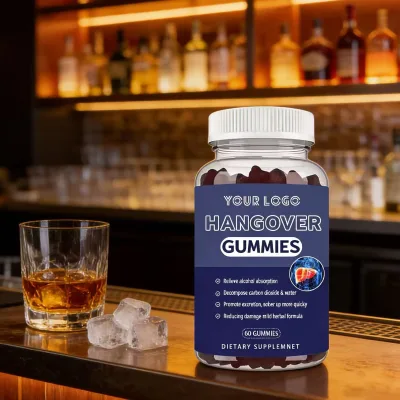
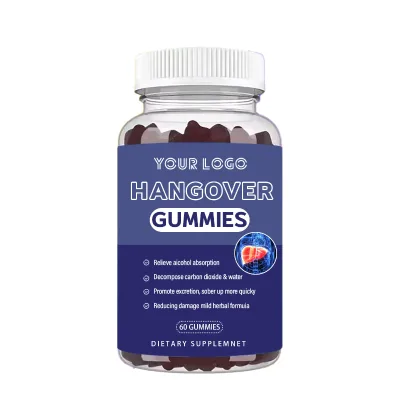
Listings for natural hangover relief gummies cluster around a consistent product format: herbal or vitamin-based gummy candy positioned for liver support, hangover relief, and related wellness benefits such as immune support and stomach nourishment. Current listings show 60 gummies per bottle as the dominant specification, with serving sizes of two gummies, a two-year shelf life, and fruity flavor profiles including blueberry, strawberry, orange, and mango. Most products are produced in Guangdong, China, and are marketed toward adults, with pregnant women, newborns, teenagers, and children commonly excluded from the applicable population. Buyers should treat these attributes as typical listing signals rather than guaranteed product traits.
The category also shows strong private-label orientation. Brand names in listings are frequently generic or OEM-designated, and suppliers advertise OEM/ODM services, customized labels, bottle packing, and customizable shapes such as bear, drop, heart, and cola forms. This indicates the market is primarily structured for resellers building their own brands rather than for purchasing established brands. Confirm early whether a listing represents a stock formula available for relabeling or a fully custom formulation requiring development time.
Technical Specifications to Verify
Anchor your specification sheet on the core format details observed across listings: gummy count per bottle (60 is common), per-serving dose (two gummies), individual gummy weight (one listing cites 3 g per piece), flavor, and shape. Require the supplier to state the active herbal or vitamin content per gummy, since "herbal" and "vitamins hangover" appear as main ingredients in listings but do not reveal actual inclusion levels. Verify whether the formula is a standard stock recipe or a customized blend, and confirm flavor and shape customization options in writing before sampling.
Shelf life claims of 24 months appear consistently, but you should request the stability data or basis behind that claim, especially if you modify the formula, flavor system, or packaging. Confirm storage requirements—listings specify a cool, dry place—and ensure your distribution chain can maintain them. Also verify gummy texture performance across temperature ranges during shipping, as soft candy formats can deform in transit. Finally, agree on the exact bottle capacity, packing configuration, and carton quantities so that warehouse receiving and retail unit counts match your sales channels.
Compliance and Safety Documentation
Start with the certifications suppliers actually list: GMP, HACCP, and ISO appear across the category and should be verified with current, in-scope certificates, not just logos on a listing page. Ask for the certificate bodies, validity dates, and whether the certified scope covers gummy candy or supplement production specifically. Food grade designation is also cited in listings; confirm what grade documentation supports it and which market regulatory framework your destination country applies to ingestible gummies.
Because hangover relief products often make functional claims—liver support, immunity, hangover relief—you must confirm which claims are legally permitted in your target market and whether the product qualifies as a food, dietary supplement, or therapeutic good there. Request full ingredient declarations with allergen statements, and confirm the formula excludes ingredients restricted in your market. Note that listings consistently exclude pregnant women and children; ensure your labeling carries appropriate warnings and age guidance. For any custom formulation, require third-party or in-house testing for identity, potency, and contaminants before each production run, and retain documentation for the full shelf life period.
Cost Drivers and Commercial Terms
Observed listing prices range widely, roughly from a few cents to ten dollars per unit, reflecting differences in formula complexity, gummy count, packaging, and order scale. Your unit cost will be driven primarily by active ingredient content, flavor and shape customization, bottle and label materials, and order volume. Observed MOQs span from single samples to 100,000 units, so negotiate MOQ tiers that allow a pilot order before committing to mass production. Confirm whether quoted prices include bottling, labeling, and carton packing, or whether these are line items.
Commercial terms to settle early include sample availability—listings indicate samples are supported or available, usually at a cost—and the division of tooling or mold fees for custom shapes. Clarify Incoterms, payment schedule, and who bears cost if a first production run fails your approved-sample comparison. Because most suppliers offer OEM/ODM private label service, ask how branding changes affect price and lead time; a stock formula with your label typically prices below a bespoke formula. Always request a pro forma invoice itemizing every cost component to avoid hidden charges at production.
Supplier Qualification and Quality Control
Qualify suppliers by matching claimed capabilities to verifiable evidence. All observed listings originate from Guangdong, China, a concentrated gummy manufacturing region, which makes differentiation dependent on factory audits and documentation rather than location. Request the GMP, HACCP, and ISO certificates, production floor photos or video walkthroughs, and—ideally—an on-site or third-party audit for larger commitments. Prioritize factories that manufacture in-house over trading companies if you need formula control, though trading companies can simplify communication for smaller orders.
Build a quality control protocol into the contract. Require a golden sample approved before mass production, in-process checks on gummy weight, moisture, and appearance, and pre-shipment inspection against an agreed AQL sampling plan. Specify testing for the active herbal or vitamin content per batch, plus microbiological and heavy metal screening appropriate to gummy candy. Define how batch numbers, production dates, and expiry dates are printed on bottles, and require certificates of analysis per shipment. Agree in advance on the remedy for failed inspections—rework, replacement, or credit—so disputes do not stall your launch timeline.
Long-Term Procurement Checks
Treat the first orders as a qualification phase. Track fill accuracy, gummy count consistency, label print quality, and damage rates across your initial shipments, and compare each batch against the golden sample. Review whether shelf life performance holds in your climate during warehouse storage, given the cool-and-dry storage requirement. Feed defects back formally and monitor whether the supplier responds with corrective actions rather than only credits; consistent root-cause responses are the strongest signal of a partner worth scaling with.
As volumes grow, revisit the commercial and regulatory foundation annually. Refresh certificate copies before they expire, reconfirm that functional claims on your labels remain compliant in each destination market, and re-approve the formula if the supplier changes ingredient sources or flavor suppliers. Negotiate volume-based pricing tiers and consider locking capacity during peak seasons, since gummy production demand fluctuates. Maintain a documented second-source option—even if unused—to preserve negotiating leverage and continuity. Finally, keep your specification sheet version-controlled so that any customization, from shape to flavor, is traceable to an agreed, dated document.
Natural Hangover Relief Gummy Sourcing Summary
The natural hangover relief gummy category offers mature, private-label-friendly manufacturing concentrated in Guangdong, with consistent formats—60-count bottles, two-gummy servings, fruity flavors, 24-month shelf life, and OEM/ODM customization—already established across listings. Success in sourcing depends less on finding the format than on verifying what listings do not show: real certification scope, actual active ingredient levels, claim legality in your market, and honest shelf life and quality performance. Anchor every decision to an approved sample, a documented specification, and batch-level testing, and use pilot orders to qualify suppliers before scaling. Buyers who convert observed listing signals into verified, contract-backed requirements will be positioned to build a durable private-label brand in this category.
FAQs
What are natural hangover relief gummies and how do they work?
Natural hangover relief gummies are herbal or vitamin-based supplements taken as chewable candy to support liver function and recovery after drinking. They typically come in fruit flavors and are taken in small daily servings, such as 2 gummies per serving. Formulations often combine herbal ingredients with vitamins, and effects vary by individual.
What is the typical dose and bottle specification for these gummies?
A common specification is 60 gummies per bottle, with a dose of 2 gummies per serving, giving a full month of servings from one bottle. Some listings describe the format as 3g per piece across 60 pieces. Exact specifications can be customized, so buyers should confirm the format with the manufacturer before ordering.
Which certifications should buyers check when sourcing these gummies?
Listings commonly reference GMP, HACCP, and ISO certifications, which indicate that the production facility follows recognized quality and hygiene management practices. Buyers should verify that certificates are current and match the specific factory producing their order. Certification requirements may also depend on the destination market and its import regulations.
Can the gummies be customized with a private label or brand name?
Yes, OEM and ODM private label services are widely offered for hangover relief gummies. Customization typically covers the brand name, label design, bottle packaging, and sometimes flavor, with fruit flavors such as blueberry, strawberry, orange, and mango available as standard options. Minimum order quantities apply, so confirm customization requirements with the supplier.
Who should not take hangover relief gummies?
Listings for these gummies generally state that they are intended for adults and are not suitable for pregnant women, newborns, or children, with some listings also excluding teenagers. Buyers should review the label for applicable and non-applicable people statements and follow local regulations when marketing adult-use supplements in their region.
How should hangover gummies be stored and what is their shelf life?
The listed shelf life is 2 years, or 24 months, from production. Gummies should be stored in a cool, dry place away from heat and moisture to preserve texture and quality. Buyers should confirm batch dating and shelf-life documentation with the manufacturer, especially when importing to markets with labeling requirements.